

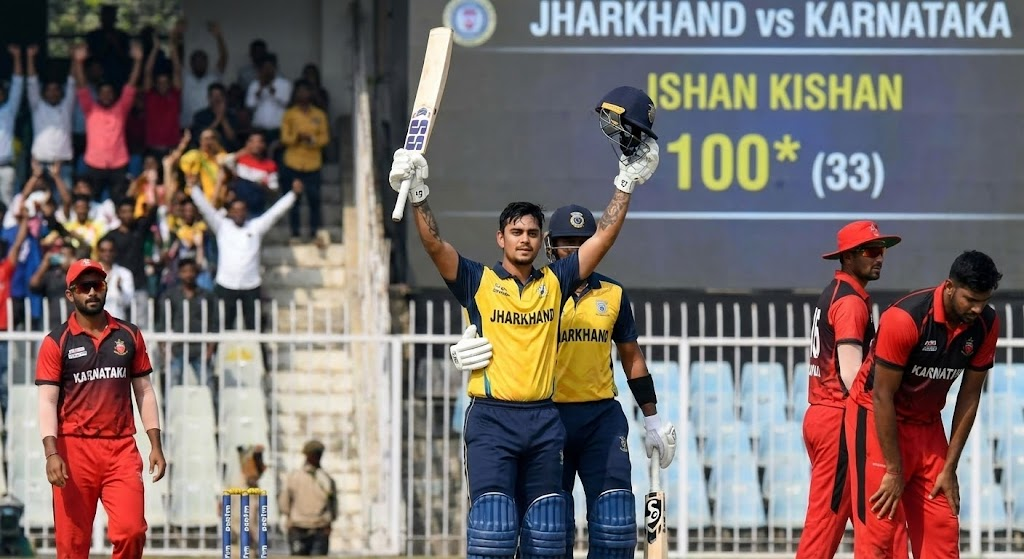
Ahmedabad, December 24, 2025: In a thunderous display of power hitting and record‑breaking batting, Ishan Kishan produced one of the most explosive knocks in the history of Indian domestic cricket on Wednesday, smashing a century off just 33 balls for Jharkhand against Karnataka in their Vijay Hazare Trophy 2025‑26 Group A clash at the Narendra Modi Stadium B Ground in Ahmedabad. The innings was the second‑fastest List A century ever by an Indian batter and underscored Kishan’s scintillating form ahead of international selection discussions.
The Vijay Hazare Trophy, India’s premier domestic 50‑over tournament organized by the Board of Control for Cricket in India (BCCI), kicked off with a host of high‑octane performances on its opening day. Among these, Kishan’s breathtaking assault on the Karnataka bowling attack stood out as a match‑defining moment, providing Jharkhand with an imposing total and putting Karnataka on the back foot from early in the contest.
A Record‑Breaking Strike
Kishan’s innings of 125 runs off just 39 deliveries came at a blistering strike rate of over 320, featuring 14 towering sixes and seven fours, as he decimated the Karnataka attack in the late overs of the Jharkhand innings.
His century came off only 33 balls, making it the second‑fastest List A hundred by an Indian, trailing only Sakibul Gani’s 32‑ball century scored on the same day for Bihar against Arunachal Pradesh. That rare feat saw both of the fastest List A hundreds by Indian batters happen on the same afternoon, etching the 2025‑26 Vijay Hazare Trophy opening round into record‑book lore.
The context of Kishan’s innings made it even more compelling. Batting at number six with Jharkhand’s innings needing impetus, he arrived at the crease at a critical juncture when the team was yet to post a commanding total. His ability to read the bowling, take calculated risks, and find boundaries with remarkable consistency turned the innings into a spectacle of offensive mastery.
From Jharkhand’s Middle Order to Match Control
Before Kishan’s fireworks, Jharkhand’s innings had seen a measured build‑up. Openers Virat Singh and Kumar Kushagra had stitched together a crucial 129‑run partnership for the fourth wicket, providing the platform for a late assault. Singh’s aggressive 88 off 68 deliveries and Kushagra’s stylish 63 off 47 balls helped steady the innings and laid the foundation for the record‑setting finish.
But it was Kishan’s arrival that truly swung the momentum in Jharkhand’s favour. As soon as he began to unfurl his big shots, Karnataka’s bowlers were left searching for answers. The innings was a masterclass in both power and timing, as Kishan exploited any short‑ball length and punished mis‑directed deliveries with ruthless precision.
By the time Jharkhand completed their 50 overs, they had amassed a mammoth total of 412 for 8, leaving Karnataka with a daunting run chase ahead. Such a score in a List A match sets the stage for dramatic cricket, and Jharkhand’s dominance was clear from their batting depth to late‑innings acceleration.
Explosive Power Hitting and Cricketing Context
Ishan Kishan’s innings has already sparked widespread discussion across cricketing circles about the evolution of power batting in the modern game. The ability of players to manipulate the field, accelerate scoring in the death overs, and maintain such an astonishing strike rate in a 50‑over match highlights how domestic cricket has become a breeding ground for international‑style aggression.
Kishan’s strike rate of 320.51 and his sheer boundary count reflect not just brute force but careful game awareness. Unlike many traditional innings that rely on accumulating runs gradually, his was a performance tuned entirely to modern cricket’s demands where rapid scoring spells the difference between competitive and commanding totals.
His achievement casts a sharp spotlight on his place in the national setup. Kishan recently earned a recall to the Indian squad for the New Zealand ODI series and the T20 World Cup, thanks to strong performances in domestic cricket and the Syed Mushtaq Ali Trophy, where he topped run‑scoring charts and played a pivotal role in Jharkhand’s maiden title win.
Scoring such an influential century at this stage not only solidifies his credentials as one of India’s most destructive batters but also sends a clear message to the BCCI selectors about his readiness for sustained international challenges. Analysts are already suggesting that this innings may be pivotal in discussions on team selection for the upcoming ODI series and beyond.
Karnataka’s Bowling Response and Match Situation
Karnataka, historically one of the more consistent sides in domestic cricket, struggled to contain the onslaught as the Jharkhand total surged past 400. Their bowlers delivered moments of control earlier in the innings, but the late assault proved too much to handle.
Despite the relentless pressure, Abhilash Shetty was the standout performer for Karnataka with the ball, finishing with an impressive 4 for 72, showcasing skill and tenacity even in a challenging bowling environment. His efforts, however, were undermined by the sheer scale of Kishan’s assault and the earlier partnership between Singh and Kushagra.
As Karnataka prepared to chase one of the highest targets seen in the Vijay Hazare Trophy’s history, the scene was set for a gripping second half of the match. A total above 400 in List A cricket is rarely easy to knock off, and while Karnataka boasts quality batters of its own, they are now faced with a monumental task under Ahmedabad’s bright lights.
Broader Impact on Domestic Cricket
Ishan Kishan’s knock did not exist in isolation. The opening day of the Vijay Hazare Trophy brought a flurry of record‑breaking performances that underlined the explosive potential of India’s emerging players. In a Plate League fixture, Bihar posted the highest team total in List A history (574 for 6), driven by centuries from Vaibhav Suryavanshi and Sakibul Gani, further amplifying the tournament’s historic start.
The remarkable feats recorded on the same day — including multiple ultra‑fast centuries — signal a shift in the domestic game toward high‑impact batting that mirrors global cricketing trends. Coaches, selectors, and fans alike are taking note as these innings demonstrate the value of aggressive play in shaping match outcomes and redefining performance benchmarks.
For Kishan, leading such an assault augurs well not just for his personal ambitions but for the prestige of Jharkhand cricket. His leadership and batting could play a pivotal role as the team aims for a deep run in the competition, using this victory as a foundation for confidence and momentum.
What’s Next for Kishan and Jharkhand
As the Vijay Hazare Trophy progresses, Kishan and Jharkhand will be under increased scrutiny. Their batting line‑up has now set a benchmark for potency, and opponents will need to devise strategies to counter such explosive hitters. Jharkhand’s ability to blend experience with sentiment — given Kishan’s international aspirations — adds an intriguing subplot to the tournament’s narrative.
For Ishan Kishan personally, this innings is more than a statistical highlight. It reaffirms his transition from domestic stalwart to a player capable of producing match‑winning performances on big stages, and it could well influence national team decisions. With selectors watching closely, Kishan’s place in India’s ODI and T20 contingents for upcoming international series looks increasingly secure — if he continues to produce such breathtaking displays.