
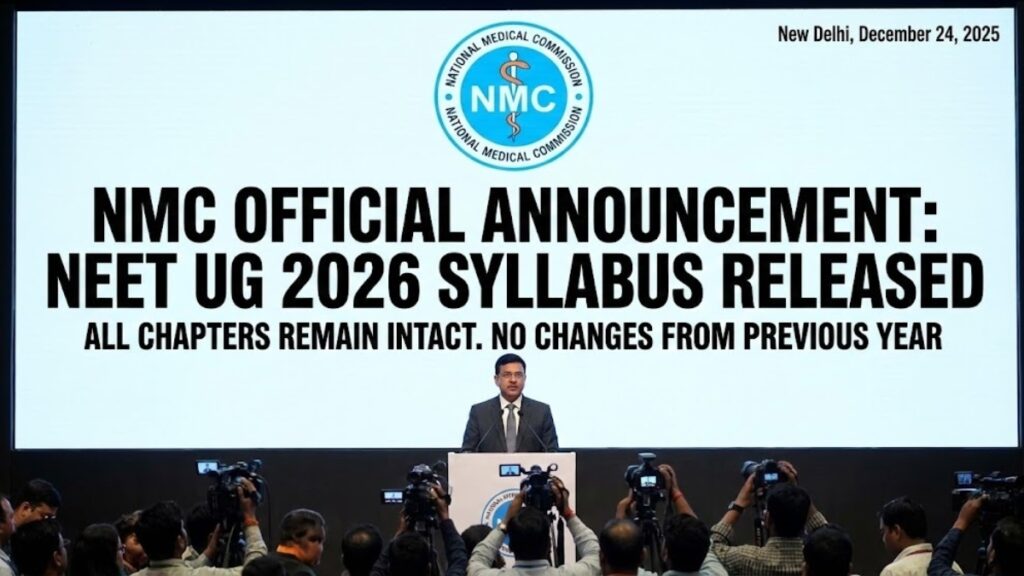
New Delhi, December 24, 2025 — The National Medical Commission (NMC) has officially released the NEET UG 2026 syllabus, providing clarity to millions of medical aspirants preparing for one of India’s most competitive entrance exams.
The updated syllabus will be applicable for admissions to MBBS and other undergraduate medical programmes for the 2026‑27 academic session. According to the commission’s official notification, no chapters have been removed from physics, chemistry or biology, and the syllabus retains the same structure as previous years.
Aspirants, coaching institutes and educators welcomed the announcement, which is expected to guide study plans and preparation strategies going into the new year.
Key Highlights of the NEET UG 2026 Syllabus
The syllabus released by the NMC outlines the topics from Physics, Chemistry and Biology that will be tested in the NEET UG 2026 exam. The commission confirmed that the paper will continue to be broadly based on the NCERT curriculum for Classes 11 and 12, which remains the backbone of the examination.
Although the notice refers to an “updated syllabus”, the content is consistent with the previous cycle. A detailed comparison of the 2025 and 2026 syllabi shows no deletion or major change in the subject‑wise topics. This consistency is expected to provide stability to aspirants who have been preparing according to the earlier pattern.
The syllabus document is now available on the NMC’s official website, nmc.org.in, making it accessible to students across the country. The commission has advised aspirants and educational institutions to refer to the updated document for accurate topic lists and planning.
Physics: Foundational and Advanced Concepts
Under the NEET UG 2026 physics syllabus, students will encounter topics that span the fundamentals of mechanics to modern physics and experimental skills. Key areas include:
- Physics and Measurements
- Kinematics
- Laws of Motion
- Work, Energy and Power
- Rotational Motion and Gravitation
- Properties of Solids and Liquids
- Thermodynamics and Kinetic Theory of Gases
- Oscillations and Waves
- Electrostatics and Current Electricity
- Magnetism and Electromagnetic Induction
- Optics and Electromagnetic Waves
- Dual Nature of Matter and Radiation
- Atoms and Nuclei
- Electronic Devices
- Experimental Skills
These topics cover both theoretical understanding and practical application, as questions in NEET UG often test conceptual clarity alongside numerical problem‑solving abilities.
By retaining the full set of physics chapters from the previous NEET cycle, the NMC has avoided any confusion or disruption that can arise when syllabi are reshuffled close to an exam year. This allows students and teachers to maintain continuity in preparation.
Chemistry: Three Pillars of Modern Chemistry
The NEET UG 2026 chemistry syllabus is organised into three key streams — physical, inorganic and organic chemistry. Each part addresses essential concepts that are crucial for medical aspirants:
Physical Chemistry
Concepts include basics of chemistry, atomic structure, chemical bonding, chemical thermodynamics, solutions, equilibrium, redox reactions and chemical kinetics.
Inorganic Chemistry
Focuses on the classification of elements, periodicity, properties of p‑block, d‑ and f‑block elements, and coordination compounds.
Organic Chemistry
Covers purification and characterisation of organic compounds, basic organic principles, hydrocarbons, organic compounds containing halogens, oxygen and nitrogen, biomolecules, and practical chemistry principles.
This division of chemistry enables students to build a strong foundation in all subfields that contribute to medical science and clinical understanding.
Biology: The Heart of Medical Entrance Preparation
Biology remains the most extensive and scoring section of the NEET UG exam, reflecting its relevance to the medical profession. The 2026 syllabus includes major topics from both Class 11 and Class 12, ensuring comprehensive coverage:
Class 11 Biology
- Diversity in the Living World
- Structural Organisation in Animals and Plants
- Cell Structure and Function
- Plant Physiology
- Human Physiology
Class 12 Biology
- Reproduction
- Genetics and Evolution
- Biology and Human Welfare
- Biotechnology and its Applications
- Ecology and Environment
These topics are central to building a conceptual understanding of life sciences, human physiology and ecological systems — all of which are crucial for aspiring doctors.
The Biology syllabus’s continuity from previous exams means that students who have worked through the NCERT‑aligned content throughout their Class 11 and 12 years can continue with focused revision rather than overhauling their preparation.
What the Syllabus Release Means for Aspirants
For students preparing for the NEET UG 2026 exam, the release of the syllabus is a major milestone. It provides clarity on what to study, allows for detailed study plans, and reduces uncertainty about potential changes. Unlike years when syllabus controversies or updates cause disruption, this year’s announcement offers stability with the confirmation that all major chapters remain intact across subjects.
Aspiring students typically begin serious preparation months — often years — ahead of the exam date. With the syllabus finalised, coaching centres and educators can align their lesson plans and mock tests to match the official content, helping students pace their studies effectively.
Experts and educators say that having a definitive syllabus well before the exam season allows candidates to focus on mastering concepts rather than worrying about missing chapters or curricular changes. This kind of clarity is particularly valuable for students balancing board exams with NEET preparation.
Planning and Preparation Strategy
Now that the syllabus is final, students are expected to form structured study schedules. Experts typically recommend a subject‑wise and chapter‑wise timetable that balances learning, revision and practice tests.
Many aspirants aim to complete the entire syllabus several months before the exam date. Once the core syllabus is covered, students often shift focus to solving previous years’ NEET question papers and taking mock tests, as these help with time management and understanding question patterns.
Although the NTA — which conducts NEET UG — has not yet announced exact exam dates or registration windows, historical trends suggest that registration may begin in early February 2026, with the exam likely to be scheduled in May. Last year’s NEET UG was held in early May, and similar timing is expected for 2026, although students are advised to check the official site for updates.
Continued Importance of NCERT Textbooks
Even though the NMC syllabus follows NCERT content closely, the National Testing Agency (NTA) does not recommend any specific textbooks. However, NCERT books remain the de facto study source for NEET UG preparation due to their alignment with the syllabus and depth of explanation suitable for entrance exam standards.
Students often use additional reference books and coaching material alongside NCERT concepts to gain broader exposure to question types and advanced applications. Yet, the foundation of a solid NEET preparation strategy remains rooted in mastering the NCERT curriculum.
Expert Advice and Aspirant Reactions
Education experts have noted that the syllabus consistency is a positive signal for NEET UG 2026 aspirants. Professors from leading coaching institutes suggest that with the syllabus unchanged, students who have already begun studying based on the earlier pattern will find their preparation on track without needing to scramble to adjust topics.
Many students welcomed the announcement on social media and educational forums, expressing relief that the syllabus remains stable and predictable. For many, the confirmation allows them to focus entirely on studying rather than worrying about last‑minute curriculum changes.
What’s Next: Registration and Exam Schedule
With the syllabus out, all eyes are now on the National Testing Agency (NTA) to release the official exam notification and registration dates for NEET UG 2026. Information on the application process, eligibility criteria, exam centres and admit card issuance will be made available on the NTA’s official portal, neet.nta.nic.in, once announced.
Aspirants are advised to stay tuned to official communications and avoid unofficial or speculative sources that may circulate incorrect details about dates or syllabus changes.
Conclusion
The National Medical Commission’s publication of the NEET UG 2026 syllabus marks a significant step for medical aspirants preparing for one of India’s most competitive exams. With the core content unchanged and clearly outlined across Physics, Chemistry and Biology, students now have a solid framework to plan their preparation strategically.
While the NTA will soon announce key logistical details such as exam dates and registration windows, the syllabus release itself is an essential milestone that brings clarity and confidence to millions of hopeful candidates aiming to pursue medical education in 2026‑27.