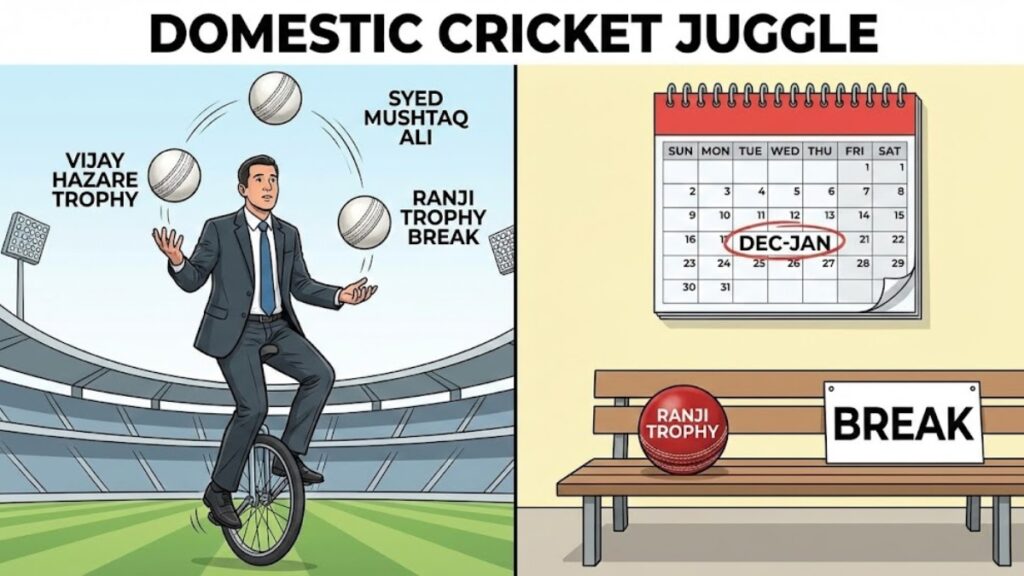
New Delhi, December 29, 2025 — India’s domestic cricket season — already a complex mosaic of formats and tournaments — is once again under the spotlight as players raise concerns over the placement of white-ball competitions during breaks in the first-class Ranji Trophy schedule.
According to players quoted by The Hindu, squeezing in limited-overs tournaments during the Ranji break may be counterproductive for cricketers’ workloads and the broader development of the longest format’s specialists.
The issue has gained traction as the domestic calendar becomes increasingly crowded, with traditional red-ball commitments intersecting with List A and T20 events aimed at grooming talent for India’s white-ball future.
What the Players Are Saying
While The Hindu report itself did not carry a byline accessible in full text, a social-media notice from the publication highlights that domestic cricketers Khare and Bawne voiced that the current placement of white-ball tournaments during Ranji Trophy breaks is “not ideal.”
The concern is that instead of providing players a rest or focused block for red-ball cricket, the break has been repurposed for other championships, thereby preventing a genuine transition between formats and uninterrupted preparation for first-class matches.
This sentiment reflects a broader unease among some professional cricketers who believe that the physical and mental toll of constantly switching formats — especially in the long season — could undermine performance and skill development.
How the Domestic Schedule Is Structured
India’s domestic framework includes multiple competitions across formats:
- The Ranji Trophy is India’s premier first-class multi-day competition, a foundational platform for red-ball cricketers.
- The Vijay Hazare Trophy and other List A events showcase 50-over cricket (similar to ODIs), feeding into limited-overs national squads.
- T20 tournaments are also woven in, including the Syed Mushtaq Ali Trophy, catering to T20 specialists.
In many recent seasons, the Board of Control for Cricket in India (BCCI) has broken up the Ranji schedule to accommodate these white-ball events, ostensibly to balance opportunities and ensure players stay match-fit across all formats.
However, some players feel this approach may dilute focused preparation for the Ranji Trophy’s red-ball rigors.
Players’ Perspective: Continuity vs. Context Switching
Domestic players often speak about the difficulty of moving from four-day matches — which test patience, technique and concentration — to the faster rhythms of one-day or T20 cricket, and then back again with little breathing room.
According to the The Hindu summation, cricketers like Khare and Ankit Bawne believe that inserting white-ball tournaments in the middle of Ranji breaks denies players the chance to rest, train specifically for red-ball cricket, or maintain rhythm in the longer format.
Veteran campaigners argue that all formats deserve dedicated windows, rather than fragmenting Ranji Trophy preparation, especially when matches in the national first-class championship can span up to four days per game and demand sustained concentration.
Contrasting Views from Within the System
Not everyone shares this concern. Some senior players and captains have previously endorsed the break system, suggesting that scheduled interspersing of formats can keep players mentally fresh and help them retain skills across formats — a necessary trait in modern international cricket where players often switch formats quickly.
For example, Times of India reported earlier that Mumbai captain Shardul Thakur supported splitting Ranji fixtures with white-ball tournaments, saying that switching formats mirrors what international cricketers regularly face, making domestic players more adaptable and prepared for top-level competition.
That adds nuance: while some players see constant format changes as disruptive, others view it as strategic preparation for the demands of contemporary cricket.
Burnout and Workload Concerns
Sport scientists and performance coaches globally warn against excessive format switching without adequate recovery periods. Formidable mental adjustment is required to recalibrate mindset, pacing, and tactical approach between formats.
One academic study on tournament scheduling highlights that tightly packed fixtures with irregular breaks can contribute to performance inconsistency and athlete burnout, particularly if rest and tailored preparation blocks are missing.
This research underscores that scheduling cricket across formats — especially when players transition from multi-day to limited overs with minimal notice — can complicate conditioning and risk overuse injuries if not managed proactively.
Impact on Player Development and Selection
The debate isn’t merely academic; it has tangible implications for player pathways:
- Emerging red-ball specialists may miss uninterrupted periods of match practice due to sudden format shifts.
- Selection committees may find it harder to judge long-format readiness if players constantly alternate between formats.
- Talented all-rounders may thrive, but red-ball purists could find their skills degraded by frequent contextual switches.
In recent seasons, selectors have closely monitored domestic performances across formats for national team recruitment. Consistency in first-class cricket remains an important benchmark for Test selection; uninterrupted Ranji blocks can help showcase long-format aptitude more clearly.
Scheduling Challenges for BCCI
For the BCCI, balancing players’ needs with broadcast rights, commercial fixtures, and tournament reach is complex. White-ball cricket — especially faster formats — tend to draw stronger viewership and sponsorship, which means scheduling them effectively also factors into financial imperatives.
At the same time, preserving the traditional Ranji Trophy — a competition with deep historical and developmental significance for Indian cricket — remains a priority. Any perceived imbalance in schedule allocation draws scrutiny from players, coaches, and pundits alike.
Player Voices: Khare and Bawne in Context
While the full The Hindu story gives space to players expressing that white-ball tournaments during Ranji breaks are “not ideal,” it’s worth noting who these players are:
- Ankit Bawne is a seasoned Maharashtra first-class batsman with over a decade in domestic cricket, known for his consistency in longer formats and contributions in List A cricket as well.
- Khare likely refers to another domestic specialist who regularly features in Ranji competition, representing the viewpoint of players deeply invested in red-ball performance.
Their perspective reflects the sentiment of many career domestic cricketers for whom extended focus on first-class rhythm is seen as crucial not just for personal statistics, but for honing skills relevant to potential selection for India A tours and Test contention.
Pause vs. Play: How Ranji Breaks Have Evolved
Historically, the Ranji Trophy — India’s premier **first-class competition — ran almost continuously through the domestic season, with limited interruptions for shorter formats.
But as One Day Internationals and T20 cricket gained prominence, the schedule became more fragmented. Presently, players are expected to juggle an evolving calendar that features:
- Several rounds of Ranji matches
- List A tournaments like the Vijay Hazare Trophy
- T20 competitions feeding into franchise leagues and national selection
This evolution reflects how modern cricket increasingly emphasizes multi-format adaptability — which many international players already navigate — but poses questions for those whose strengths lie predominantly in the traditional, patience-oriented game.
What’s Next for the BCCI?
Cricket administrators are unlikely to ignore player feedback. As the domestic season unfolds and authorities prepare the calendar for the 2026/27 season, conversations around scheduling — including how best to align Ranji blocks with other tournaments — will likely continue both inside and outside the BCCI’s planning sessions.
If greater balance is sought, possible approaches could include:
- Longer continuous Ranji windows without interruptions
- Dedicated formats blocks with built-in rest periods
- Tailored windows to allow players to prepare for each format’s physical and tactical demands
The players’ concerns voiced in The Hindu add important weight to this ongoing discussion, emphasizing that scheduling isn’t merely a logistical exercise but a core component shaping career development, performance quality, and the health of domestic cricket in India.
Summary
Domestic cricketers, including Khare and Ankit Bawne, have publicly expressed that squeezing white-ball tournaments into the break periods of the Ranji Trophy is “not ideal”, arguing it disrupts focus and preparation for first-class cricket.
This debate highlights broader challenges in Indian domestic scheduling as players balance red-ball and limited-overs formats amid an increasingly crowded calendar.
While some administrators and players see benefits in format switching for adaptability, others call for clearer blocks and rest periods to support performance and development.