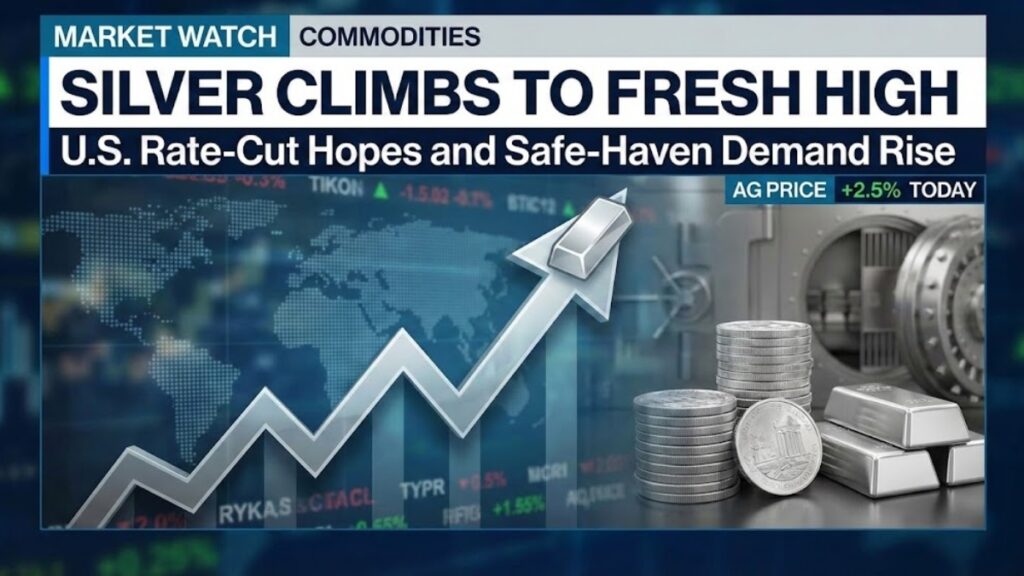
Mumbai / New Delhi, December 29, 2025 — Silver prices surged sharply on Monday, reaching fresh multi-year highs as market expectations of U.S. Federal Reserve interest rate cuts and increased safe-haven demand drew investors toward precious metals. The rally reflects a deeper shift in global financial markets, where policy forecasts, geopolitical uncertainties, and supply-demand imbalances are reshaping commodity trends.
According to Investing.com, silver prices jumped over 7 percent in Indian rupee terms, settling around ₹2,39,787 per kilogram — a significant surge for the white metal often seen as both a store of value and an industrial commodity.
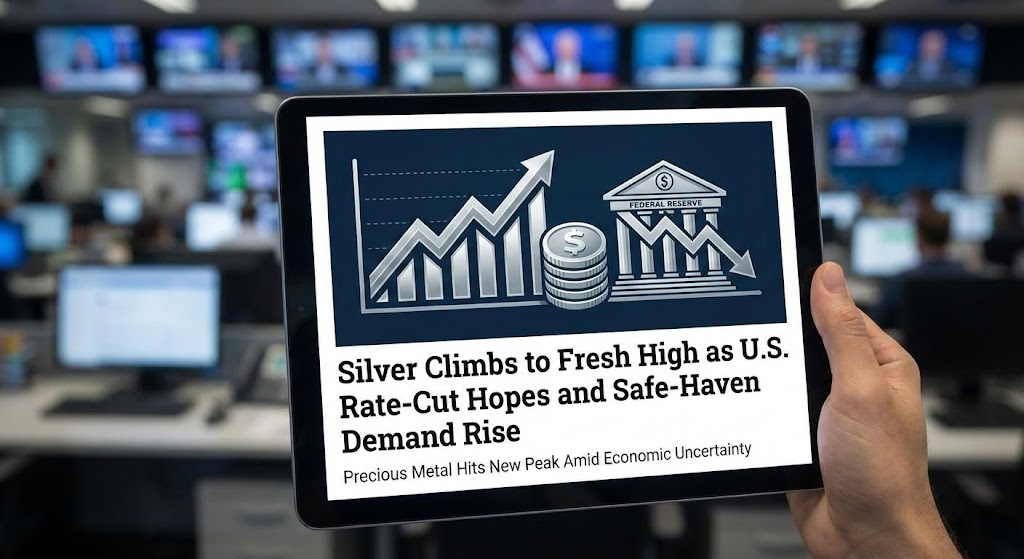
Why Silver Is Rallying: Key Market Drivers
U.S. Rate-Cut Expectations
One of the major factors pushing silver prices higher is growing belief among investors that the U.S. Federal Reserve will begin cutting interest rates next year. Mixed U.S. economic data — including solid GDP growth paired with softening consumer confidence and flat factory output — have led markets to price in multiple potential rate cuts as policymakers respond to cooling activity.
Lower interest rates typically weaken the U.S. dollar and reduce the opportunity cost of holding non-yielding assets such as silver, making precious metals more attractive. A softer dollar also makes commodities priced in dollars cheaper for holders of other currencies, further boosting demand.
Safe-Haven Demand Amid Uncertainty
In times of economic or geopolitical uncertainty, investors often turn to metals like silver and gold as safe-haven assets. With tensions persisting in global markets and economic data mixed, investors are moving toward tangible assets perceived as more stable than equities or currencies. This pattern has helped silver prices break past significant psychological and technical thresholds.
Silver’s dual role as both an investment asset and an industrial metal broadens its appeal. Demand rises not only from investors seeking shelter from volatility but also from manufacturers that use silver in electronics, solar panels, electric vehicles, and other technologies.
Record Levels and Historical Gains
Silver’s surge in 2025 has been remarkable. Earlier this month, the metal crossed key global benchmarks, moving past $75 per ounce — a level once considered out of reach — and pushing into record territory. In India’s domestic futures markets, prices have climbed to over ₹2.42 lakh per kilogram as traders react to global momentum and local demand.
Year-to-date gains for silver far outpace many commodities. 2025 has seen prices rising by more than 150 percent, one of the strongest rallies in recent commodity history. Gold has also enjoyed robust performance, with precious metals collectively drawing significant investor attention.
According to long-term market analysis, silver began the year well below its current levels and has benefited from several catalysts — including its classification as a critical mineral and ongoing structural supply deficits that have tightened inventories.
Supply Concerns and Inventory Dynamics
Another key element supporting the rally is constrained supply. Chinese silver stockpiles — a barometer for global physical inventory — fell to their lowest level in a decade, intensifying pressure on available supply even as industrial demand grows. While shipments to other markets help ease some bottlenecks, overall global inventories remain tight.
This combination of strong demand and limited supply can create a powerful upward force on prices, especially when macroeconomic conditions — such as anticipated monetary easing — are favorable.
Impact of Geopolitical and Macroeconomic Forces
Geopolitical tensions — including international economic sanctions and disruptions to commodity flows — often increase risk premiums in commodity markets. In the case of silver and other metals, these risks have reinforced investor interest in hard assets capable of preserving value during turbulent periods.
At the same time, anticipation of U.S. monetary easing adds another layer of support. If markets continue to price in rate declines in 2026, precious metals may retain their allure for longer, potentially extending the rally seen at the end of 2025 into the new year.
What This Means for Investors and Markets
Silver’s historic rise has broad implications:
- Safe-Haven Appeal: The rally highlights how commodities can attract capital during uncertainty when equities or bonds underperform.
- Industrial Demand: As a crucial industrial metal, silver benefits from long-term growth trends in technology, renewable energy, and electrification.
- Portfolio Diversification: For investors seeking alternatives in volatile markets, precious metals provide a diversification tool that can hedge against inflation and currency risks.
However, markets are also showing signs of profit-taking and volatility, with prices occasionally retreating after brief peaks. Traders should be aware that rapid gains can be followed by sharp pullbacks, especially if macroeconomic signals shift unexpectedly.
Silver Price Trends and Outlook
Technical data from futures markets shows silver trading near its 52-week highs, with price ranges and volatility reflecting heightened market activity. Yet data also suggests mixed technical signals — including indicators showing both buying and selling pressures — meaning short-term movements could be unpredictable.
Longer-term trends suggest that if rate-cut expectations solidify and supply remains constrained, silver could retain its elevated price trajectory into 2026. Conversely, if economic data unexpectedly strengthens — reducing the probability of rate cuts — or inventories increase sharply, prices could soften from current levels.
Summary
Silver prices climbed sharply to fresh multi-year highs on December 29, 2025, driven by strong U.S. rate-cut expectations and rising safe-haven demand amid global uncertainty. With supply tight and industrial demand robust, silver has delivered exceptional gains in 2025, outperforming many commodities and attracting investor interest across markets.
While long-term fundamentals remain supportive, traders should monitor macroeconomic signals and technical indicators that could influence short-term movements.