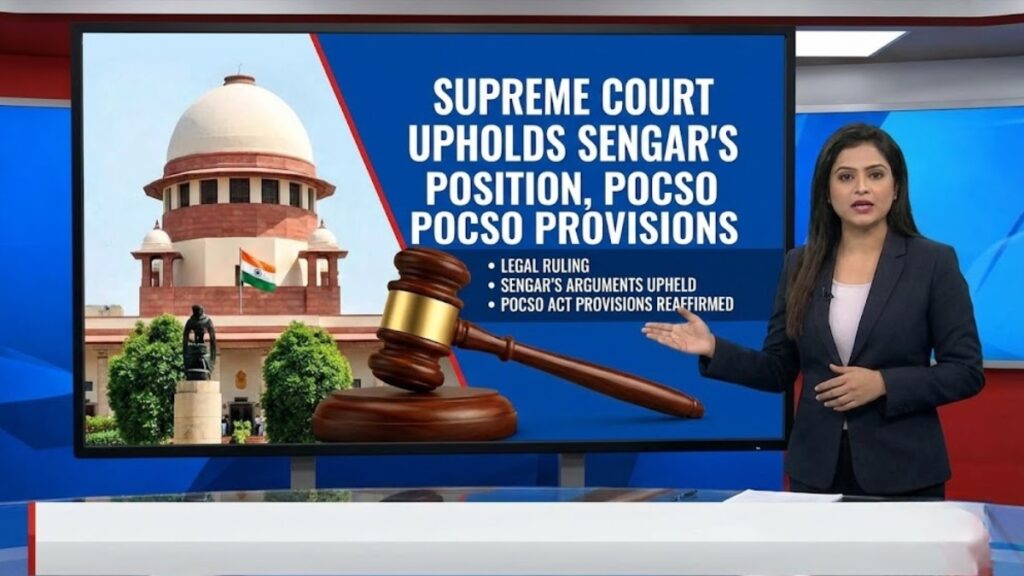
New Delhi, December 30, 2025 — The Supreme Court of India on Monday stayed a controversial Delhi High Court order that had granted interim bail to former BJP MLA Kuldeep Singh Sengar, who is serving a life sentence in the Unnao rape and sexual assault case.
In doing so, the apex court underlined the seriousness of offences under the Protection of Children from Sexual Offences (POCSO) Act and reaffirmed that stringent legal provisions must be upheld when minors are sexually assaulted by persons in positions of power.
Sengar, convicted in December 2019 for the rape of a minor and linked custodial death of her father, has been behind bars for over seven years. The case has been a prolonged legal and public battle since the Uttar Pradesh government transferred the investigation to the Central Bureau of Investigation (CBI) amid allegations of local police complicity and threats to the survivor’s family.
Background of the Controversial Bail Order
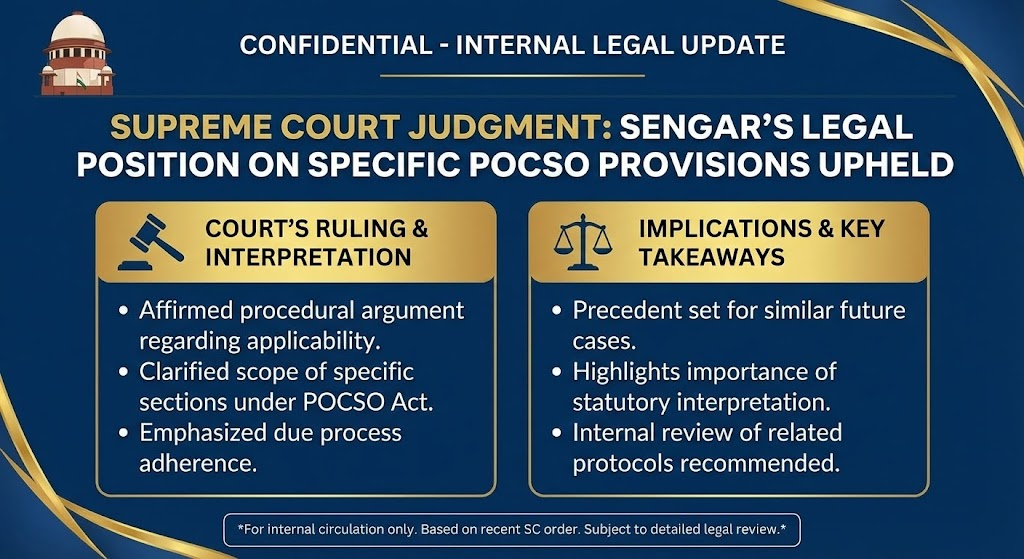
On December 23, 2025, a Division Bench of the Delhi High Court granted Sengar conditional bail while his appeal against conviction was pending. The court’s reasoning was rooted in a technical interpretation of the term “public servant” under Section 5(c) of the POCSO Act and the Indian Penal Code (IPC).
It observed that because Sengar — at the time of the offence — was an elected MLA and not a statutory public servant, the offence could not be treated as an aggravated POCSO offence requiring enhanced punishment.
Under the POCSO Act, an “aggravated penetrative sexual assault” attracts a minimum sentence of 20 years up to life imprisonment when committed by a person in a position of authority or trust, such as a police officer, hospital employee, or jail official.
The High Court held that the statutory definition of “public servant” did not clearly include elected representatives under the POCSO Act and IPC definitions, and that Sengar had already served more than the minimum sentence for a non-aggravated POCSO offence.
This interpretation sparked immediate public and legal criticism, with opponents arguing that the POCSO Act’s intent is to protect minors regardless of technical statutory definitions and that legislators wield significant influence that can coerce or intimidate survivors.
Supreme Court Intervenes: Stay on Bail Order
Responding to the CBI’s Special Leave Petition (SLP), the Supreme Court stayed the High Court’s bail order, holding that the broader legal questions raised require careful examination. The apex court noted the “dominant position” of the accused and the object and spirit of the POCSO Act that aims to protect children from exploitation and serious abuse.
A bench led by the Chief Justice issued notice in the SLP and directed that Sengar remain in custody until further orders, effectively setting aside the High Court’s bail conditions for now. The top court’s action reflects a strong judicial message that technical loopholes should not override substantive justice in cases involving minors.
Legal experts say the Supreme Court’s intervention underscores the need for a victim-centric and purposive interpretation of statutes like POCSO that were enacted precisely to safeguard children from sexual abuse and exploitation.
Legal and Social Implications
The case has reignited debate over the interpretation of the term “public servant” in POCSO and similar statutes. Critics point out that earlier High Court reasoning, which distinguished elected legislators from traditional public servants, could create a loophole in prosecution for powerful individuals accused of crimes against minors.
Advocates for child protection law reform argue that such interpretations risk diluting legislative intent, especially when dealing with heinous crimes involving children. They contend that the legal framework must ensure no gap through which influential offenders can evade stringent penalties.
Moreover, this development has broader social resonance at a time when public trust in the criminal justice system’s ability to deliver justice in high-profile sexual offence cases remains strained. The POCSO Act, enacted in 2012 and amended in 2019, was designed to offer special protections for children, including 24/7 courts, stringent punishments, and provable safeguards. Upholding its strict provisions signals the judiciary’s commitment to defending those protections.
What This Means for the Unnao Case and Future Proceedings
For now, Sengar will continue to remain in judicial custody as the Supreme Court hears the larger questions raised by the Delhi High Court’s bail order. The next phase is likely to involve detailed argumentation on:
- Whether an elected representative should be treated as a “public servant” under the POCSO Act’s statutory definitions;
- How aggravated offences under POCSO should be interpreted in a way that serves the Act’s protective purpose;
- Whether statutory technicalities should yield to the overall objectives of child-safety legislation.
Legal analysts suggest that the Supreme Court’s stay reflects caution against setting a precedent that could weaken POCSO’s strict punitive regime. The case may ultimately clarify how courts balance statutory definitions with the overarching goal of shielding children from abuse by individuals in positions of authority or trust.
The timing of this judicial intervention is significant. As cases of sexual offences involving minors continue to dominate public attention, courts are under pressure to ensure that convictions are robust, interpretations are consistent with legislative aims, and loopholes are not exploited by well-connected individuals.
Broader Conversations on Child Safety and Law Enforcement
The Sengar case is part of a larger national conversation about child safety and the efficacy of legal protections. In recent years, courts have delivered varied judgments in POCSO cases, from upholding convictions and life sentences to occasionally modifying sentences on technical grounds.
Law reform advocates maintain that while ensuring fair trial rights is fundamental, lawmakers and courts must guard against interpretations that could inadvertently weaken protections for the most vulnerable. Many argue for legislative amendments that explicitly define categories like “public servant” in child protection statutes, thereby closing ambiguity and aligning statutory language with on-ground realities.
At the same time, human rights groups say justice and child safety should be priority goals in all interpretations, and that victim protection and dignity must remain central to legal processes.
Conclusion
The Supreme Court’s decision to stay the bail granted to Kuldeep Singh Sengar highlights the judiciary’s commitment to upholding stringent provisions of the POCSO Act, particularly in cases involving serious sexual crimes against minors.
By emphasizing the dominant position of the accused and the protective object of the law, the apex court has set the stage for a broader legal review that could clarify key statutory interpretations.
The outcome of this judicial scrutiny will have significant implications, not just for this high-profile case, but for future prosecutions under POCSO and related criminal laws.
As India continues to grapple with legal frameworks addressing child safety and sexual offences, the courts’ role in interpreting and enforcing these laws will remain central to public trust and the nation’s commitment to justice.