
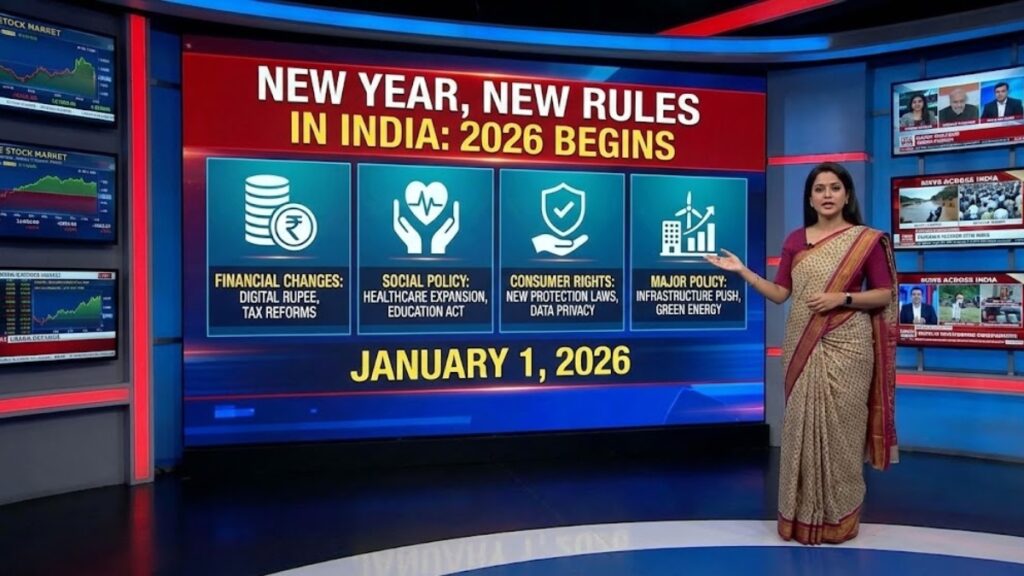
As India ushered in 2026, more than just the calendar changed. A sweeping set of new government rules, regulations and reforms took effect on January 1 that will reshape everyday life for citizens, workers, businesses and taxpayers across the country.
These new rules touch on personal finance, banking, transportation, taxation, social welfare, digital security and more — delivering a notable shift in how ordinary Indians will live, work and interact with government systems this year.
The momentum for change stems from a series of policy decisions made in 2025, including tax reforms, digitisation mandates, public administration updates and economic restructuring efforts. As the year begins, these reforms are now moving from planning to implementation — and their effects are expected to be widely felt.
Mandatory PAN-Aadhaar Linking Takes Effect on January 1
One of the most widely discussed changes from the start of 2026 is the enforcement of PAN-Aadhaar linking. For many years, the Indian government has been urging individuals to link their Permanent Account Number (PAN) cards with their Aadhaar identity numbers to improve tax compliance and reduce fraud.
The deadline for linking ended on December 31, 2025, meaning that from January 1, 2026, PAN cards that are not linked with Aadhaar may be declared inactive or invalid.
The consequences of an invalid PAN are significant:
- Individuals may not be able to file income tax returns or claim refunds.
- Opening or operating bank accounts may be restricted.
- Access to government subsidies, benefits and key financial services could be blocked until the linkage is completed.
This alignment strengthens the government’s digital compliance goals but also puts pressure on citizens to complete the process immediately to avoid disruptions.
Central Pay Structures Updated: 8th Pay Commission Implementation Begins
Another major change effective January 1 is the implementation of the 8th Pay Commission, which replaces a pay structure that has been in place for years for central government employees and pensioners.
The Pay Commission periodically reviews government salaries, allowances and pensions for millions of public servants across India. The transition to the 8th Pay Commission is expected to:
- Revise base salary scales for central government employees.
- Adjust allowances such as dearness allowance and housing support.
- Affect pension computations for current and retired officials.
However, while these revised scales became effective on January 1, actual implementation timelines for pay increases or pension recalculations may roll out in phases over the coming months.
Banking, Fuel and Utility Price Mechanisms Updated
From the very first day of 2026, several shifts in financial and utility pricing rules came into effect:
- Banks began applying enhanced credit score updates on a weekly basis, meaning consumer credit profiles will reflect recent financial behaviour more quickly.
- LPG prices for commercial cylinders increased sharply, while domestic cylinder rates remained steady.
- Aviation turbine fuel (ATF) prices were cut, which could influence airline operating costs.
These pricing adjustments influence household expenses, business operating costs, travel and logistics economics in different ways.
Digital Finance and UPI Faces Tighter Rules
The intersecting worlds of digital payments and banking security saw changes designed to curb fraud and strengthen verification safeguards from January 1:
- UPI (Unified Payments Interface) transaction norms are now more stringent, with additional safeguards to prevent unauthorised or fraudulent transactions.
- Banks are enforcing tighter SIM verification and authentication procedures for digital communication apps which are often used for banking verification.
These measures aim to protect consumers, but users are advised to be ready for additional verification steps when conducting high-value or sensitive digital transactions.
Vehicle and Safety Rule Changes on the Horizon
Though not all automotive changes took effect on January 1 itself, significant safety mandates for vehicles are slated for April 2026:
- Advanced Emergency Braking Systems (AEBS), Driver Drowsiness Monitoring, and Lane Departure Warning Systems (LDWS) will be required on all new passenger vehicles, commercial trucks and buses.
These systems are designed to reduce fatal road accidents by improving driver response and collision avoidance. By mandating such technologies, India aligns its vehicle safety norms with international best practices.
Tax Reforms and the New Income Tax Framework
The Indian government has already passed the Income-tax Act, 2025, a comprehensive overhaul replacing the outdated 1961 tax law.
While the full framework of the new tax law will come into force on April 1, 2026, the momentum starts in January. This reform promises to:
- Simplify direct tax provisions.
- Introduce a consolidated fiscal year definition to align reporting.
- Revise TDS/TCS compliance norms and tables for easier understanding.
This forward-leaning tax regime is designed to modernise India’s tax administration and lessen legal complications that have plagued taxpayers for decades.
Tariff-Free Exports to Australia Begins
One change with international economic implications is the tariff elimination on Indian exports to Australia. From January 1, 100% of Indian goods entering Australia will attract zero import duty under the India-Australia trade pact.
This move is expected to:
- Boost Indian exports in sectors such as textiles, pharmaceuticals and food products.
- Strengthen trade ties and balance bilateral commerce.
While the immediate impact may take months to appear in trade figures, this agreement reflects India’s increasing emphasis on global trade partnerships as a driver of economic growth.
Transport Services: ‘Bharat Taxi’ App Launch
In the realm of urban mobility, January 2026 is set to see the launch of the Bharat Taxi app — a government-backed cab service aimed at offering a safe, affordable and reliable alternative to existing private ride-hailing platforms such as Ola and Uber.
The service, expected to begin operations by the end of January 2026, will operate initially in New Delhi and other major cities.
Its launch underscores a broader effort by policymakers to promote public-sector participation in tech-driven markets while addressing concerns over fares, service quality and driver welfare.
Cost of Buying a Car Rises in 2026
Consumers planning to purchase a new vehicle in 2026 will likely see higher prices. Major manufacturers — including Nissan, BMW, MG Motor, Renault, Tata Motors and Honda — have announced price hikes of up to 3%.
These increases reflect broader cost pressures in global supply chains, raw material inflation and investment in new technologies such as electric and hybrid drivetrains.
For buyers, this means the total cost of ownership for new cars will edge upward in the coming months, reinforcing the importance of budgeting ahead of purchase decisions.
Other Regulatory and Governance Reforms on the Way
Across government departments, a range of regulatory changes are set to continue unfolding across 2026:
- Deregulation 2.0 Initiative: The Centre plans new deregulation measures targeting compliance reduction in 30 priority areas to boost ease of doing business and reduce bureaucratic hurdles.
- Gig Worker Social Security Rules: Proposed draft rules seek to extend social security coverage to gig workers, requiring minimum work thresholds with single aggregators to qualify.
Such reforms seek to modernise India’s economic ecosystem and adapt labour protections and regulatory frameworks to 21st-century needs.
What This Means for Ordinary Indians in 2026
Together, these changes mark one of the most comprehensive policy shifts in recent memory. Everyday citizens will notice effects in multiple ways:
- Compliance responsibilities increase with PAN-Aadhaar linking and digital transaction scrutiny.
- Central employees and pensioners are entering a new pay regime.
- Tax structure changes will reshape long-term financial planning for individuals and businesses alike.
- Consumers face higher car and LPG costs, even as fuel pricing undergoes periodic review.
- Digital finance and transport innovation reflect a shift toward greater technology use in daily life.
Meanwhile, economic policy initiatives and global trade adjustments signal India’s ambition to strengthen its position in international commerce in 2026 and beyond.
Summary
As India welcomed 2026, major new rules and reforms took effect that will influence financial behaviour, employment income, social security, consumer costs, digital transactions, export trade and transportation services. Highlights include:
- Mandatory PAN-Aadhaar card linking starting January 1.
- Implementation of the 8th Pay Commission for central employees.
- Changes to banking and fuel pricing mechanisms.
- Enhanced digital payment and UPI norms.
- Airport taxi app launch plans and tariff-free exports to Australia.
- Pending tax reforms and vehicle safety mandates scheduled for 2026.
These changes reflect India’s broader strategic direction — shifting toward economic modernization, regulatory streamlining and digital integration. For citizens and businesses alike, the months ahead will involve adaptation and opportunities as new rules take root in everyday life.