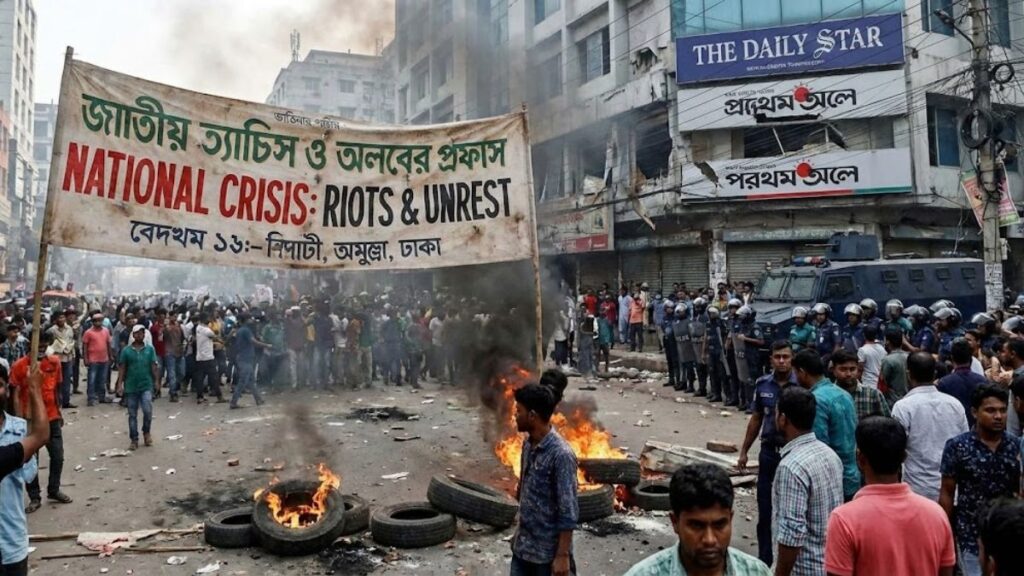
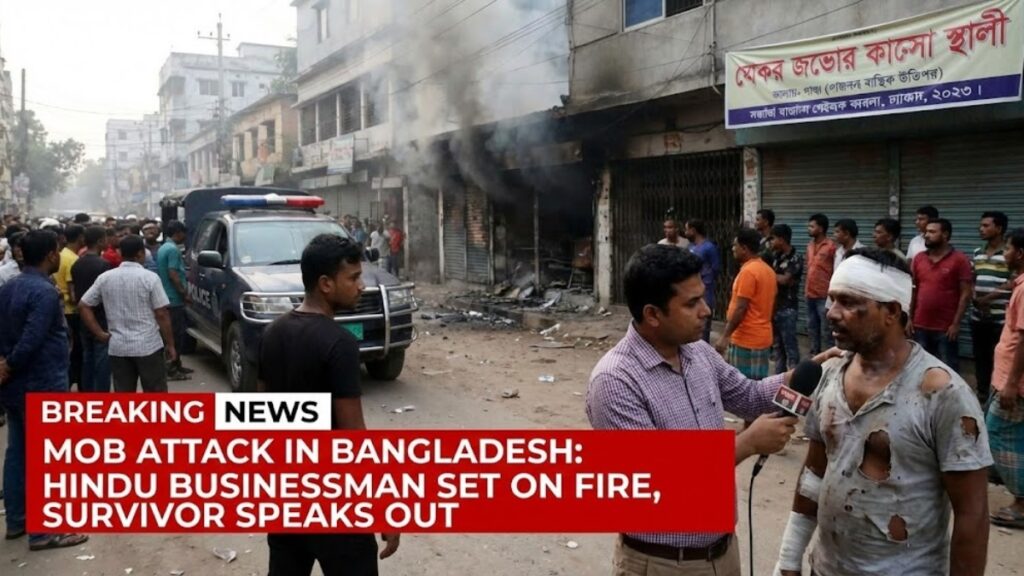
A horrific incident unfolded in Bangladesh’s Shariatpur district on Wednesday night when a 50-year-old Hindu businessman was brutally attacked, hacked, stabbed and set on fire by a mob, forcing him to take desperate measures to save his life by jumping into a nearby pond. The violent assault — one of several recent attacks on members of the minority Hindu community in the country — has sparked alarm locally and regionally.
The victim, identified as Khokon Chandra Das, runs a pharmacy and mobile banking business in Keurbhanga Bazar of Koneshwar Union in Damudya Upazila. The attack took place around 9:30 pm on New Year’s Eve as he was returning home from closing his shop.
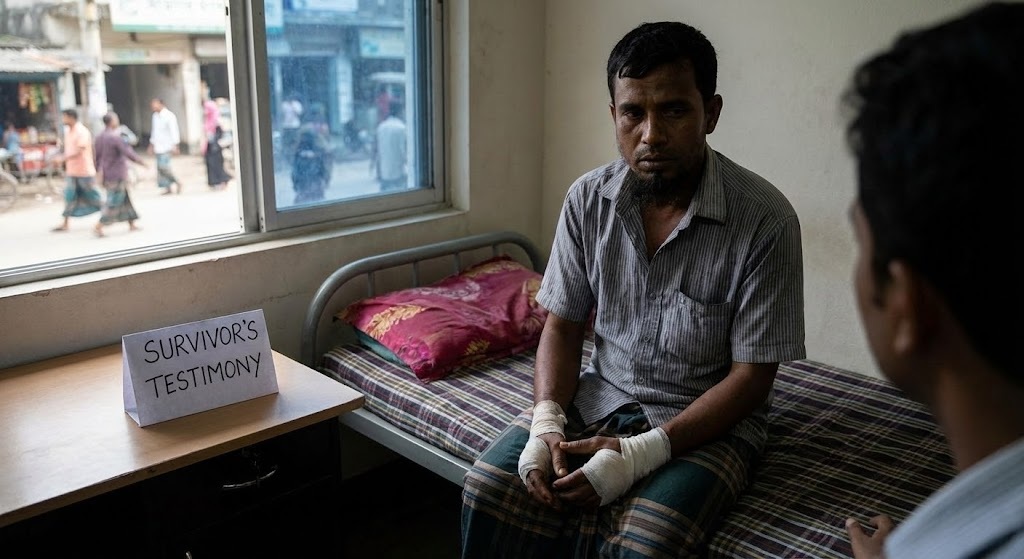
Sequence of Events: Violent Assault on New Year’s Eve
According to police reports and local media, Das was riding in an auto-rickshaw with his day’s earnings when a group of assailants stopped the vehicle along the Damudya–Shariatpur road near Keurbhanga Bazar. He was allegedly dragged out of the vehicle and assaulted with sharp weapons before the attackers poured petrol over his body and set him on fire.
In a desperate bid to survive, Das jumped into a nearby pond, which extinguished the flames and allowed him to escape further physical harm. His screams alerted local residents, who rushed to help and forced the attackers to flee the scene.
First aid was administered at Shariatpur Sadar Hospital, but due to the severity of his injuries, including stab wounds and extensive burns, Das was later transferred to a hospital in Dhaka for advanced treatment. Authorities described his condition as critical and serious.
Profile of the Victim and Family Statements
The victim, Khokon Chandra Das, was identified as a 50-year-old local businessman who owned and operated a pharmacy and a mobile banking business. Residents described him as a simple man with no known enemies or disputes. His wife, Sima Das, said the family was still struggling to understand why he had been targeted.
She told reporters that her husband had no known conflicts with anyone, and that the attack came out of the blue. In some reports, she claimed that Das recognized two attackers, though it is unclear whether that recognition was rooted in personal animosity or another motive.
Police Response and Investigation Efforts
Officials from the Damudya Police Station confirmed that the attack occurred and that investigations are underway. Two alleged members of the group, identified as Rabbi and Sohag, have reportedly been named in connection with the attack, although formal arrests had not been confirmed as of the latest reports.
Law enforcement is working to identify other members of the gang and to determine the full motive behind the assault, including whether robbery, personal disputes, communal tensions or other factors played a role.
Context: A Series of Attacks on Hindu Minorities
This assault is not an isolated event. Multiple reports indicate that Das’ attack is the fourth such violent incident against individuals from the Hindu community in Bangladesh over the past two weeks.
Earlier incidents include the beat-to-death lynching of Dipu Chandra Das, a 27-year-old garment factory worker in Mymensingh district. He was allegedly beaten and hanged before being set on fire in mid-December, with no evidence found to support the blasphemy charges that fueled the mob violence.
Another case involved Amrit Mondal, who was killed in a separate mob attack in Rajbari district’s Pangsha sub-district. These killings and attacks have raised concerns about the safety and security of minority communities, particularly Hindus, in Bangladesh.
Wider Reaction and Public Outcry
News of the violent attack on Das has sparked reactions from human rights groups, community leaders and regional observers. Many have condemned the brutality of the incident, saying it highlights a disturbing pattern of mob violence and intolerance toward minority groups.
Social media and civil society actors have also raised concerns about the broader security environment for religious minorities in Bangladesh, calling on authorities to act swiftly to protect vulnerable communities and prosecute perpetrators of hate-based violence.
Protests against the spate of incidents have been reported in parts of India, where activists demand justice and accountability for the attacks on Hindus in Bangladesh. Some demonstrations have framed the violence as evidence of rising communal tensions, underscoring the emotional and political weight of the issue across borders.
Government and Diplomatic Dimensions
While Bangladeshi authorities have confirmed police investigations, the government’s broader response has not been fully outlined in public statements. The incident draws attention to the ongoing challenge faced by Bangladesh in ensuring law and order and safeguarding minority populations.
In past cases of minority violence, governments and diplomats from neighboring countries, including India, have sometimes expressed concern or urged thorough investigations. Whether this attack triggers formal diplomatic engagement remains to be seen. Observers note that the treatment of minorities can impact bilateral perceptions and regional relations, especially where large diaspora communities reside.
Community Fear and the Impact on Minorities
For many in Bangladesh’s Hindu community, this attack and prior incidents have caused fear and anxiety about safety. These events have repeatedly drawn attention to the broader issue of communal violence and law enforcement challenges.
Local residents near Shariatpur have recounted how quickly a peaceful evening can turn violent — underscoring the precarious position of minorities in some areas. When the attackers fled after Das’ cries, it was local bystanders who came to his rescue, highlighting both the dangers people face and the importance of community intervention.
Analysts say that when incidents occur in quick succession, they can cause deep psychological trauma and erode trust in law enforcement’s ability to safeguard all citizens equally.
Medical Treatment and Prognosis
Doctors treating Das described the extent of his injuries as serious. In addition to burn wounds, he suffered multiple stab and hacking injuries to various parts of his body, including his limbs and abdomen. He was initially admitted to Shariatpur Sadar Hospital before being transferred to a Dhaka Medical College Hospital for more advanced care due to his critical condition.
Medical staff have warned that recovery from such severe burns and physical trauma can take weeks or months and will likely require extensive follow-up treatment, including skin grafts, rehabilitation and infection control.
Unclear Motive, Heavy Questions
While robbery has been mentioned in some accounts — because Das was carrying his day’s earnings — several news reports note that his wife and family have insisted he had no personal enmity or disputes with anyone.
Police are investigating whether robbery was the primary motive or whether the crime was driven by religious or communal bias, personal grudges, or a mixture of factors. The fact that two attackers have been named suggests authorities are trying to piece together the chain of responsibility and motive behind such a brutal assault.
Without clear evidence or formal charges yet made public, speculation about motive remains open — but the context of recent attacks on minority Hindus adds significant concern about communal motivations.
Broader Patterns and Minority Rights Concerns
Experts say that the frequency and brutality of recent incidents — with several attacks on Hindus in the past weeks — may point to larger social tensions in Bangladesh. Although Bangladesh’s constitution provides for religious freedom and equality before the law, on-the-ground dynamics sometimes reflect sectarian friction or social unrest.
Civil society organisations have urged authorities to safeguard minority communities more effectively, to prosecute perpetrators of communal violence swiftly, and to ensure that justice is seen to be done to prevent cycles of retaliation or escalation.
International human rights groups have often highlighted attacks on minorities in the region as areas of concern, calling for greater accountability and protection measures. Such incidents can have implications beyond national borders, affecting perceptions of human rights practices and religious tolerance in Bangladesh.
Voices from the Ground and Aftermath
Local news outlets and social media have been documenting community reactions. Some residents say they are shocked and disturbed by the level of violence, especially on what should have been a peaceful New Year’s Eve. Others have stressed the need for solid police action and speedy trials for those responsible.
Community leaders have called for calm and for Allen investigations into all recent attacks on minorities, appealing for people to resist vigilante justice or escalations that could arise from anger or fear.
Summary
A Hindu businessman, identified as Khokon Chandra Das, was brutally attacked, stabbed, hacked and set on fire by a mob in Bangladesh’s Shariatpur district on New Year’s Eve. Das survived by jumping into a nearby pond, which extinguished the flames, but he remains in critical condition with serious injuries.
The incident adds to a series of recent attacks on minority Hindus in Bangladesh, prompting concern from communities and human rights observers. Police have named two suspects and are continuing investigations, but motives remain unclear beyond early reports of robbery or recognition of attackers by the victim.
Local residents rescued Das and took him for emergency care, and his family says he had no known enemies. The incident has sparked alarm over community safety and fuelled calls for stronger protection and legal action against such violent mob attacks.