
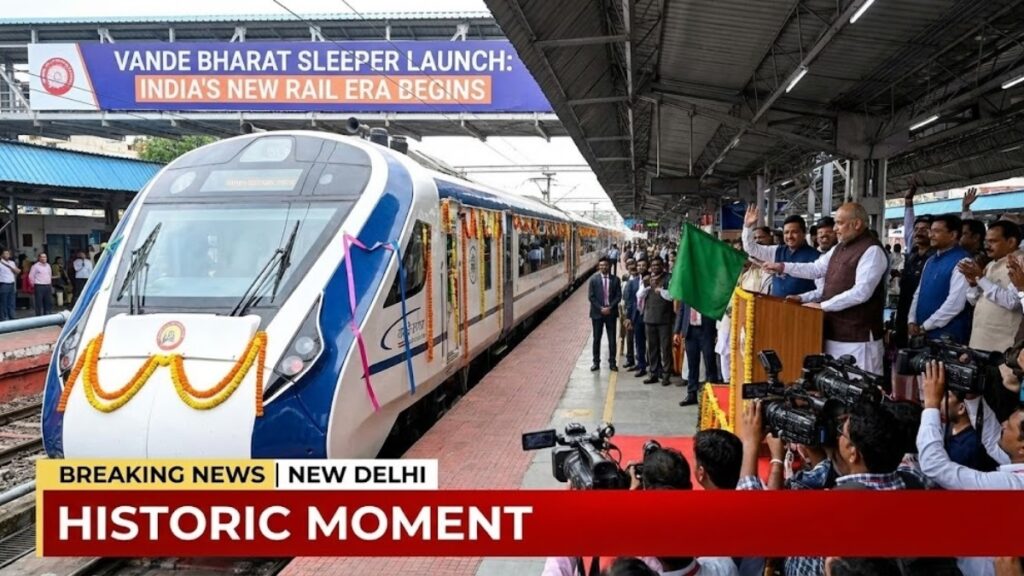
India’s rail network is on the cusp of a major transformation with the launch of its first-ever Vande Bharat Sleeper train — a modern, semi-high-speed overnight train designed to redefine long-distance rail travel.
This development comes after the train successfully completed high-speed trials, reaching 180 km/h, highlighting Indian Railways’ push toward faster, safer, and more comfortable sleeper services for passengers.
Here’s what you need to know about this milestone, including features, fares, routes and what this means for the future of train travel in India.
Latest on India’s Vande Bharat Sleeper Train Rollout


Speed Milestone: 180 km/h Trials Demonstrate World-Class Capability
The Vande Bharat Sleeper train has just passed a major technical test — it achieved a top speed of 180 km/h during a final high-speed trial on the Kota–Nagda section under the supervision of the Commissioner of Railway Safety (CRS).
During the test, engineers also conducted a striking “water-glass test,” where glasses filled with water remained steady at high speed — an informal but visually compelling demonstration of the train’s ride stability and advanced suspension system.
While the train can physically reach such high speeds, Indian Railways has indicated that operational service speeds will be capped lower initially (around 130 km/h) for safety and signalling reasons, even though the design and trials confirm its high-speed capability.
This achievement underscores India’s progress in indigenous rail technology and supports broader modernization goals under national initiatives like Atmanirbhar Bharat.
What Makes the Sleeper Version Different
Unlike existing daytime Vande Bharat services — which are mainly chair-car trains for short or medium routes — the Vande Bharat Sleeper is built for overnight journeys, featuring fully-air-conditioned sleeper berths and modern amenities that are a step above traditional long-distance express trains.
Key Features
- 16 fully air-conditioned coaches — includes 11 AC 3-tier, 4 AC 2-tier and 1 AC First Class coach.
- Large capacity: up to 823 passengers.
- Ergonomic sleeper berths with improved cushioning.
- Automatic plug doors and sealed gangways for safety and comfort.
- Advanced suspension and noise reduction for smooth overnight travel.
- KAVACH anti-collision system and emergency talk-back facilities.
- Enhanced safety: fire detection/suppression, CCTV, modern toilets and centralized coach monitoring.
- Sanitation tech: UV/C disinfectant systems for passenger hygiene.
Passengers will notice the difference in comfort, ride stability and onboard features compared with older overnight trains — making the new Vande Bharat Sleeper a premium alternative for long-distance rail journeys.
Route and Launch Plans
The first commercial service of the Vande Bharat Sleeper is planned between Guwahati and Howrah (Kolkata), providing vital overnight connectivity between the Northeast and eastern India.
Prime Minister Narendra Modi is expected to flag off the inaugural run later in January 2026, making this one of the most important rail rollouts of the year.
This route was chosen for its strategic importance and relatively long distance — roughly 960–1000 km — where sleeper comfort and speed improvements make the biggest difference for travellers.
Fares: Affordable Premium Travel
Despite its premium positioning, the railways have kept fares comparatively accessible, hoping to attract passengers who normally choose rail travel — and even those who might otherwise fly:
- AC 3-tier: ~₹2,300 (including food)
- AC 2-tier: ~₹3,000
- First AC: ~₹3,600
These fares are significantly lower than typical flight costs on the same route, which can range from ₹6,000 to ₹8,000 or more, depending on timing and demand.
Including meals in the ticket price for longer journeys adds value — especially for travellers who previously had to purchase food separately or rely on station vendors.
Modern Comfort Meets Practical Travel Needs
The Vande Bharat Sleeper train merges speed with comfort, offering amenities designed specifically for overnight journeys — an area where most current train services in India still lag behind:
- Ergonomic berths make long trips more restful.
- Noise-reduced cabins and advanced suspension improve ride quality at higher speeds.
- Safety systems like KAVACH and centralized monitoring elevate standards.
- Automatic doors and vestibules make boarding and movement easier, even at night.
For frequent travelers — business travellers, families, students or elderly passengers — these enhancements signal a new era in domestic rail travel that is faster, safer and more comfortable across India’s vast overnight routes.
Scaling Up: More Trains and Future Growth
The sleeper variant isn’t a one-off experiment. Indian Railways plans to introduce about 12 Vande Bharat Sleeper trains by the end of 2026, expanding overnight high-quality rail travel across multiple regions.
This initiative will cover routes of 1,000–1,500 km where overnight journeys are common and demand for a better travel experience is strong — connecting major cities without requiring air travel.
Railway zones in places like Rajasthan are already exploring additional routes for Vande Bharat Sleeper services, such as a Delhi–Ahmedabad connection that could benefit passengers across the Northwest.
Why This Matters: A Step Toward Tomorrow’s Trains
The introduction of the Vande Bharat Sleeper train represents more than just a new service. It is a symbol of technological progress and passenger-centric planning in India’s rail sector.
- The successful 180 km/h trial shows the physical capability of Indian-built rail technology.
- The sleeper design responds to real travel needs on long routes where comfort is key.
- The fare strategy targets wider adoption and positions rail travel as a strong alternative to short-haul flights.
- The expansion plan points to a future where semi-high-speed overnight trains become common across India.
This project also reflects India’s focus on indigenous rail engineering and innovation — from the aerodynamic design of the coaches to sophisticated safety systems like KAVACH — emphasizing self-reliance in critical infrastructure.
Summary
India’s first Vande Bharat Sleeper train has passed a significant milestone by achieving 180 km/h in high-speed trials — setting the stage for its commercial rollout as the next big leap in long-distance rail travel.
Scheduled to launch in January 2026 on the Guwahati–Kolkata (Howrah) route, the train offers modern sleeper comfort, competitive fares and advanced safety features, representing a new era for overnight journeys.
With a planned fleet of up to 12 sleeper Vande Bharat services by the end of 2026, Indian Railways is poised to transform rail travel across the country — making premium, fast and comfortable journeys the norm.