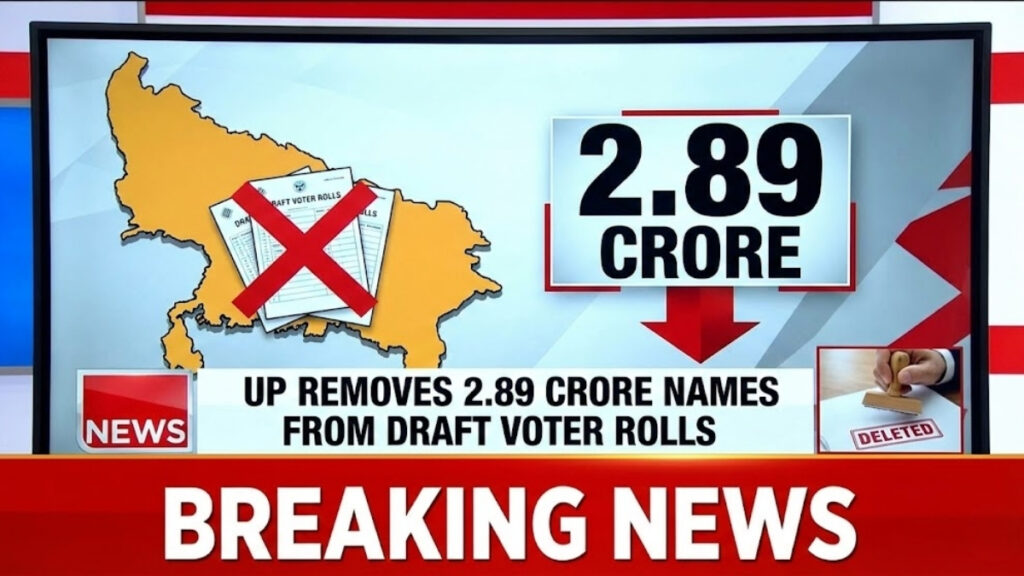
Lucknow — In one of the largest electoral roll clean-ups in recent Indian history, the Election Commission of India (ECI) has released the draft electoral roll for Uttar Pradesh following the completion of a Special Intensive Revision (SIR) exercise, deleting names of approximately 2.89 crore voters. The draft list, published on Tuesday, now lists about 12.55 crore electors across the state’s 75 districts and 403 Assembly constituencies.
The announcement was made by Chief Electoral Officer (CEO) Navdeep Rinwa, who also explained that the deleted names include a mix of deceased individuals, those who have moved out of the state, duplicates and entries with incomplete verification. Authorities have emphasised that this revision aims to ensure the electoral rolls are accurate, up-to-date and free of outdated or erroneous entries.
What the SIR Revision Did
The SIR is a comprehensive voter list revision process launched by the Election Commission to clean up electoral rolls nationwide. In Uttar Pradesh, the SIR started on October 27, 2025, and was originally scheduled to conclude on December 11.
However, due to the high volume of enumeration forms not returned or mismatches identified, the deadline was extended to December 26, 2025 before the draft roll was finally released on January 6.
Under the process, Booth Level Officers (BLOs) went door-to-door to distribute and collect enumeration forms, which voters had to sign and return. Out of the total electorate recorded prior to the revision, approximately 12.55 crore voters (81.03%) submitted valid forms. Around 2.89 crore did not return forms or had data anomalies and were therefore removed from the draft list.
Reasons for Deletions
The Election Commission said the deletions occurred for several core reasons:
- Deceased voters: Around 46.23 lakh voters were identified as deceased.
- Migrated or relocated voters: About 2.17 crore were found to have permanently moved residences or were otherwise untraceable.
- Duplicate registrations: Roughly 25.47 lakh electors were registered at more than one place in the existing rolls.
These figures together form the bulk of the roughly 2.89 crore names excluded from the draft list. This was nearly 18.7% of the total pre-revision electorate, a significant proportion compared with similar SIR exercises in other states.
Scale of the Revision and National Context
The extent of deletions in UP places it among the states with the highest number of names removed from draft rolls during the initial SIR stage. Officials noted that other populous states – like Tamil Nadu and Gujarat – recorded significant but smaller percentages of deletions at about 15% and 14.5% respectively.
The poll body defended the exercise, saying that accurate electoral rolls are crucial for fair elections and that maintaining outdated names undermines the democratic process. The SIR process is intended to improve the quality of voter data and reduce the risk of electoral fraud or confusion.
What Happens Next: Claims and Objections
The ECI has opened a claims and objections period from January 6 to February 6, 2026, during which voters whose names are missing or incorrectly recorded can apply for corrections or reinclusion. During this period, citizens can:
- File claims to re-add their names if they were wrongly deleted.
- Submit objections regarding errors in the draft list.
- Provide supporting documents such as proof of residence, identity, or proof that they were not deceased or relocated.
Eligible voters must submit applications using Form 6 along with required documentation. The Election Commission will review all claims and objections before finalising the electoral roll. After this exercise, the final voter list is scheduled to be published on March 6, 2026.
Political and Public Reactions
The massive deletion has prompted varied responses from political stakeholders. Some political groups have raised concerns over the scale of removals, alleging potential disenfranchisement or procedural issues, and have called for detailed scrutiny of deleted entries. There have been calls for authorities to ensure that the claims and objections process is user-friendly and accessible to all, especially in rural and marginalised communities.
Meanwhile, election officials have stressed that the deletions are part of a standard verification procedure and not indicative of any political motive. They have urged voters to check their status promptly and take corrective action if needed.
Impact on Voters and Election Preparedness
The updated electoral roll comes at an important juncture, with general elections and state polls scheduled in various parts of the country over the coming years. An accurate and updated voter list is essential for smooth electoral administration, preventing duplication, and ensuring that only eligible individuals participate in the democratic process.
Officials have emphasised that voters can verify their inclusion in the draft list by visiting the Election Commission’s official portal or accessing local electoral office services. The CEO’s office has also instructed booth officers and local representatives to assist citizens in checking their status and filing any necessary paperwork. NDTV India
How to Check Your Name on the Draft List
Voters in Uttar Pradesh can verify their names in the updated draft roll by following these steps:
- Visit the Election Commission of India’s website or the state CEO portal.
- Navigate to the section for draft voter lists.
- Enter details such as name, EPIC/Voter ID number, or district.
- Download and print the draft voter list for reference.
- If your name is missing, follow the procedures to file a claim for reinclusion.
Citizens are being encouraged to complete these steps as early as possible during the objection window, to avoid missing the final deadline. NDTV India
Ensuring Electoral Integrity
Electoral rolls are the foundation of representative democracy. By conducting the SIR and removing outdated or inaccurate entries, the Commission aims to create a more credible and robust database ahead of future elections. This exercise also harmonises the rolls with current demographic realities, cuts down on fake or duplicate entries and improves administrative efficiency.
However, given the sheer scale of removals, election officials have underscored the need for continued public engagement and communication. Voters who believe they were removed in error are urged to use the prescribed forms and established channels to ensure their voices are included in the final roll.
Looking Ahead to the Final Roll
Once the claims and objections window closes and all submissions are reviewed, Uttar Pradesh will publish its final electoral roll on March 6, 2026. This list will determine who is eligible to vote in upcoming elections and will be used across polling stations for verification.
The Election Commission has reiterated that the draft roll is provisional and changes may still occur before the final publication. Voters should treat the draft list as an important checkpoint but not the definitive record.
What Voters Should Keep in Mind
- Check your name early: Make sure your name appears in the draft list.
- Respond within the deadline: Claims and objections must be submitted by February 6, 2026.
- Use correct forms: Incorrect or incomplete applications may not be accepted.
- Stay informed: Official updates will be shared through the CEO’s website and local election offices.
These steps will help ensure that eligible voters are not inadvertently excluded from the final electoral roll.
Conclusion
The removal of 2.89 crore names from Uttar Pradesh’s draft electoral roll following the Special Intensive Revision represents an unprecedented effort to maintain accurate voter records. With detailed figures showing nearly 47 lakh deceased voters and extensive migration or duplication among entries, the revisions reflect both demographic realities and administrative challenges.
As the state moves into the claims and objections phase, authorities and citizens alike will be closely watching how many names are re-added and how the final list, due on March 6, shapes up ahead of future elections. Voter engagement and timely action will be key to ensuring that the democratic rights of all eligible citizens are upheld.