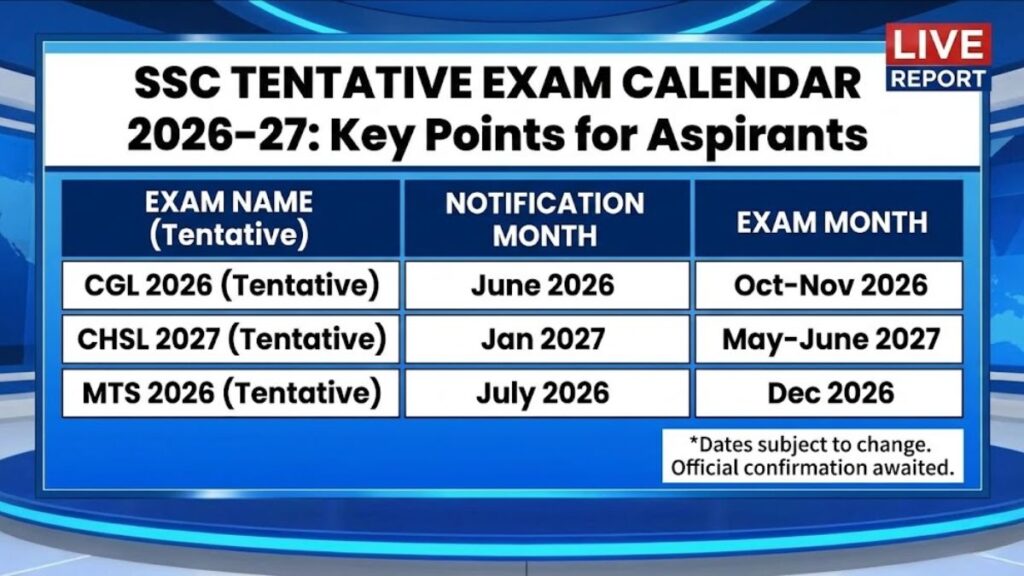
The Staff Selection Commission has published its tentative calendar of examinations for the 2026–27 recruitment cycle. The slate covers the usual big-ticket tests such as Combined Graduate Level (CGL), Combined Higher Secondary Level (CHSL), Junior Engineer (JE), Multi Tasking Staff (MTS), Selection Post phases, and specialist limited departmental exams. The calendar runs roughly from May 2026 through March 2027 and gives aspirants a first, reliable look at when notifications and exam windows will arrive.
This annual calendar is a planning tool, not a final schedule. The dates in it are tentative. For each examination the Commission will still issue a detailed advertisement that fixes application windows, exact exam dates, fee rules, reservations, and post specificities. Candidates should treat the calendar as a map for mid and long term preparation. The official SSC website will post the PDFs and notifications that supersede this calendar.
Key dates and high level timing
The calendar groups many of the major recruitment drives into two broad periods. The first cluster of notifications and computer based tests is expected in May and June 2026. This includes the Combined Graduate Level (CGL) 2026 Tier 1 exam and the Junior Engineer exam paper one. Several limited departmental and grade specific exams share the same May window.
Later in the year the Selection Post phases and other exams are scheduled to spread into the second half and early 2027. These alignments let candidates map their study blocks around likely exam months.
To illustrate, the tentative calendar lists advertisement and closing windows for exams such as JSA/LDC grade limited departmental competitive exams and ASO limited departmental exams in mid March 2026, with paper one computer based tests slated for May 2026.
The CGL 2026 Tier 1 notification period is also shown around March to April, with the exam likely in May to June 2026. Remember that the calendar is tentative and that each paper will have its own confirmed schedule later.
Why this calendar matters
For many aspirants one of the hardest parts of SSC preparation is timing. The calendar gives clarity on three things that matter most. First, it tells you roughly when your exam will be held so you can set realistic study milestones. Second, it shows which exams are clustered, which helps working candidates prioritize. Third, it flags months when application windows will open so you do not miss deadlines. Treat the calendar as a programme for preparation, not an immutable timetable.
A practical example. If you plan to sit both CHSL and CGL in the same cycle, seeing CGL in May to June lets you schedule a focused two to three month revision block before the Tier 1 window. If you are a fresher aiming for MTS or Selection Post exams that fall in the same window, you can partition evenings and weekends to cover both syllabi without burning out. The calendar gives you that head start.
What has changed in SSC operations recently
The Commission has been rolling out reforms to improve transparency and candidate experience. Recent policy shifts include making question papers, candidate responses and official answer keys more accessible. The Commission has also introduced measures like equi percentile normalization where required and reduced fees for answer key challenges.
These changes aim to reduce post exam disputes and to make evaluation fairer across multiple shifts. Such reforms will likely apply to exams in the 2026–27 calendar, but check each exam notice for specific implementation details.
These process reforms are important because they influence how candidates prepare and how they can contest results. For instance, if the Commission publishes candidate responses after the exam, aspirants gain a stronger basis to challenge any perceived errors in answer keys. That may make post exam scrutiny more transparent and less adversarial.
Tactical preparation advice
Create a calendar backward from the likely exam month
If CGL Tier 1 is in May to June 2026, mark that month as your target and schedule topic blocks starting now. Build three phases: concept, practice, and revision. Reserve the last four weeks for full length mock tests.
Prioritize high payoff topics first
For CGL that means quantitative aptitude fundamentals, data interpretation, arithmetic and reasoning. For CHSL focus on arithmetic, general awareness and basic reasoning.
Use self slotting windows, where available
SSC has begun to release self slotting for certain exams. If you see that option for your exam, book an exam slot early to avoid last minute centre or timing conflicts. Keep checking the official exam notice.
Plan applications in advance
When the advertisement is published, do not delay your application. Make sure documents such as degree certificates, caste or EWS certificates and photo IDs are ready. If you are a working candidate, factor in leave or exam day travel time.
Simulate exam day conditions
Many aspirants lose marks to exam day anxiety or keyboard unfamiliarity. Practice on computer based mock tests. Build time management habits by simulating actual exam length and negative marking, if any.
Risks aspirants should watch for
Tentative dates can shift
Administrative reasons, large scale conflicts with other national tests, or law and order issues can cause rescheduling. Keep alerts on the official SSC website and credible education desks.
Overlapping exams
The calendar shows multiple exams clustered in May to July 2026. If you plan to sit more than one, be realistic about your ability to prepare for both simultaneously.
Policy or syllabus changes
The Commission occasionally changes exam schemes. Changes such as normalization techniques, paper patterns or inclusion of new subject areas will be announced in the advertisement. Do not assume the syllabus stays identical year to year. Always cross check with the SSC syllabus page when preparing.
How institutions and coaching providers will react
Coaching centres and online platforms will quickly rework batches to align with the calendar. Expect a surge of targeted crash courses in the two months before core exams like CGL and JE. That response is both an opportunity and a caution. If you benefit from structured classes, choose a program that focuses on mock tests and adaptive feedback rather than only theory lessons.
A better approach may be a mixed model. Enroll for a short guided programme for difficult topics and rely on self practice and curated mock tests for the rest. That keeps costs lower and gives you control over pacing.
What the calendar means for government hiring
A reasonable and public calendar helps departments plan fresh recruitments. For ministries and cadre controlling authorities a published timeline reduces administrative surprises. In aggregate, a predictable schedule also helps reduce vacancy backlogs because departments can align their shortlists and interview windows more smoothly. For aspirants it means recruitment cycles are more visible and planning becomes possible. The calendar does not guarantee vacancy numbers. For that you need each post specific advertisement.
Quick checklist for candidates after the calendar release
- Bookmark the SSC official calendar PDF and the notice board.
- Prepare scanned copies of required documents in application friendly formats.
- Build a mock test schedule with at least one full test per week three months out from the target exam.
- Monitor news about exam reforms and normalization rules that may apply to your exam.
- Join candidate forums carefully. Use them to cross check facts, not to amplify rumours.
Final thoughts
The SSC tentative calendar for 2026–27 gives aspirants an early roadmap. That is the good news. The harder work remains constant. Candidates must translate the calendar into disciplined study plans, mock practice and administrative readiness. Use the calendar to set milestones, not to assume finality. Keep a habit of checking the SSC official site for the final detailed adverts and for any changes that affect application windows or exam patterns.