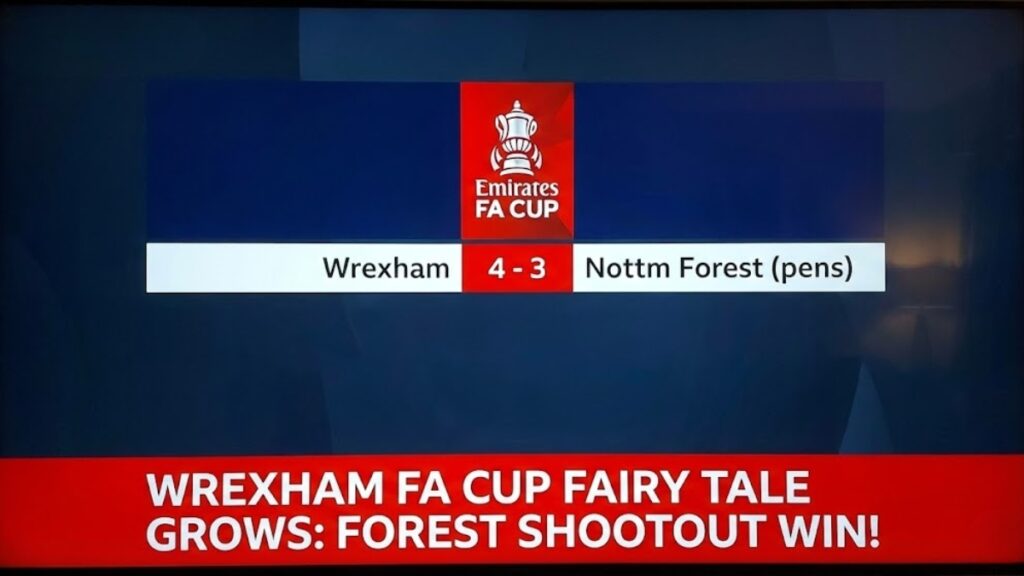
Wrexham’s rise from non-league outsiders to headline makers took another dramatic turn on Friday as Phil Parkinson’s side produced a six-goal FA Cup classic and then held their nerve in a penalty shootout to eliminate Premier League Nottingham Forest.
The 3-3 draw after extra time, settled 4-3 on penalties in Wrexham’s favour, felt at once like a statement of the club’s progress and a reminder of the Cup’s capacity to rewrite expectations in a single night.
A game of big moments
The contest at the Racecourse Ground delivered drama from the start. Wrexham seized the initiative with well-taken goals from Liberato Cacace and Oliver Rathbone, and later extended their lead when Dominic Hyam headed a third to make it 3-1. Forest rallied, however, with Callum Hudson-Odoi producing a late brace that forced extra time and eventually penalties.
The shootout ended with Wrexham goalkeeper Arthur Okonkwo emerging as the match hero, saving the decisive spot kick to send the home faithful into raptures. For a club that was rebuilding its identity six years ago, the result will be savoured as a major scalp.
Parkinson’s verdict and what “next stage” means
Manager Phil Parkinson was effusive but measured in his post-match comments. He described the win as evidence that Wrexham have moved up a level in belief and performance, and he singled out the team’s resilience as the distinguishing factor.
Parkinson’s framing of the result as the club entering a “next stage” is more than ritual optimism. It reflects growing standards on the training pitch, a recruitment strategy that blends seasoned campaigners with hungry younger players, and the institutional professionalisation that follows sustained success on the field. Parkinson contrasted this maturity with earlier eras of hope and amateurism, underlining that the club now expects to compete, not merely to make headlines.
Tactical snapshot: how Wrexham matched a Premier League side
Tactically, Wrexham combined disciplined structure with moments of bold attacking intent. Early on they pressed high and exploited Forest’s narrow defensive spaces with quick transitions down the flanks. Cacace’s goal stemmed from a well-executed overlap and a delivery that unsettled the Forest backline, while Rathbone’s finish showcased Wrexham’s ability to build patient sequences in midfield and then pierce the final third.
Defensively, Hyam’s presence on set pieces proved decisive when he converted a header to make it 3-1. When Forest shifted to a more direct approach late on, Wrexham initially struggled to close passing lanes, which allowed Hudson-Odoi to punish gaps and haul the visitors back into the tie. The extra-time period and shootout then became a test of composure, which Wrexham won. Match details and sequence of goals are recorded in official reports.
The human story: ownership, support, and a global audience
This result also reinforces the broader narrative that has followed Wrexham since the club’s takeover by Ryan Reynolds and Rob McElhenney. The Hollywood co-owners have brought global attention and increased resources, but the club’s progress has depended on decisions from the technical staff and players on the ground.
Friday’s win saw Reynolds present in the stands and celebrating with fans afterwards, a visual symbol of Wrexham’s expanded footprint and the emotional bond between club and community. That connection has helped the Racecourse Ground feel like a fortress for smaller opponents and has turned routine cup nights into global viewing events.
Forest’s response and the Premier League context
Nottingham Forest walked away with more than bruised pride. Manager Sean Dyche and his staff must weigh squad rotation, cup priorities, and how to address late-game lapses. Forest, who reached the latter stages of domestic cup competitions in prior seasons, fielded a side capable of recovering from a two-goal deficit, but the inability to close out the game in 90 minutes and the nervy shootout performance will invite scrutiny.
From a Premier League perspective, the tie underscores how quickly lower-league sides with confidence and smart coaching can unsettle established top-flight teams on a single night. Reuters’ coverage captured this upset as part of a wider FA Cup weekend in which several major shocks occurred.
Goalkeeper Okonkwo: a decisive performance
Arthur Okonkwo’s performance will be replayed in Wrexham highlights for seasons to come. His penalty saves under pressure were the kind of moments that define cup folklore. Beyond the shootout, his command of the area and shot-stopping during the game offered Wrexham the foundation they needed to challenge a technically superior squad.
For a club intent on pushing into higher divisions, having a goalkeeper who can deliver in moments of extreme pressure is a competitive advantage. The FA’s official match wrap highlights how crucial Okonkwo’s contributions were to the outcome.
Financial and strategic implications
On the surface the victory brings the usual cup perks: prize money, gate receipts from a replay or away tie if scheduling mandates it, and enhanced commercial exposure. But the strategic gains could be more important. Giant-killing nights help recruit players who are convinced by ambition and momentum rather than wage alone. They also make the club more attractive to potential investors and sponsors who seek clubs with both a story and momentum. Wrexham’s recent minority stake sale to an investor consortium is part of a broader plan to fund sustained growth, and headline results in marquee competitions will make that growth plan easier to justify.
The FA Cup narrative: giant-killings and the competition’s enduring value
This season’s third round produced a cluster of shocks, and Wrexham’s success belongs to a long FA Cup tradition of the underdog upsetting elite opposition. From Macclesfield’s dramatic triumph over Crystal Palace to Wrexham’s night, the Cup remains a showcase for football’s unpredictability and for narratives that cut across league tables.
For Wrexham supporters, the competition provides not only the possibility of silverware but also a stage to demonstrate that the club is more than a feel-good story in popular media. The competition’s capacity to reset expectations in a single match keeps it relevant across tiers of English football.
Risks and realism: sustainability and the next challenges
Even as the town celebrates, realism is necessary. Cup glory is episodic. Sustained progress through league promotion requires depth, injury management, and consistent results over months rather than weeks. Wrexham must guard against complacency and ensure it does not over-prioritise cup nights at the expense of league form.
The challenge is to translate the belief shown in shock wins into systems that produce points across an entire campaign. That means careful squad rotation, shrewd recruitment, and the development of a playing identity that can handle both the rigours of Championship football and the glamour of occasional cup runs. Parkinson’s job is to balance those demands while keeping players motivated and grounded.
Voices from the night
Parkinson highlighted collective effort and the significance of the crowd in his remarks. The FA and local media captured player and staff reactions that emphasized pride and the sense that Wrexham are now routinely capable of competing with higher-ranked opponents.
From a Forest perspective, observers pointed to late-game mechanical errors and a lack of cutting edge earlier in the contest. The talking points after the match will include Forest’s rotation choices, Wrexham’s set-piece threat, and both sides’ fitness for January’s congested calendar.
Where this leaves both clubs
For Wrexham the night will be a touchstone. It proves they can manage high-pressure, high-stakes games and prevail against elite opponents. If Parkinson and his backroom team sustain that level, the club’s ambitions of climbing domestic tiers will gain credibility with players, fans, and investors. For Nottingham Forest, the defeat is a prompt to refocus on consistency in the league and to ensure their squad depth can absorb cup distractions.
Both teams now face an immediate period of reflection and adjustment, though the headlines will rightly linger longest at the Racecourse Ground, where a community celebrated what felt like a collective achievement.
Final thought
Football lives on moments, and Friday night provided many. Wrexham’s victory over Nottingham Forest is the sort of result that feeds club lore, but its real value will be judged by what follows. If Parkinson can use this success as a building block rather than a peak, Wrexham’s “next stage” may prove to be a durable rise rather than a memorable anecdote.
Either way, the FA Cup has once again reminded the game why it matters: it gives smaller clubs a chance to rewrite the script for a night and sometimes, as Wrexham showed, to change the story for much longer.