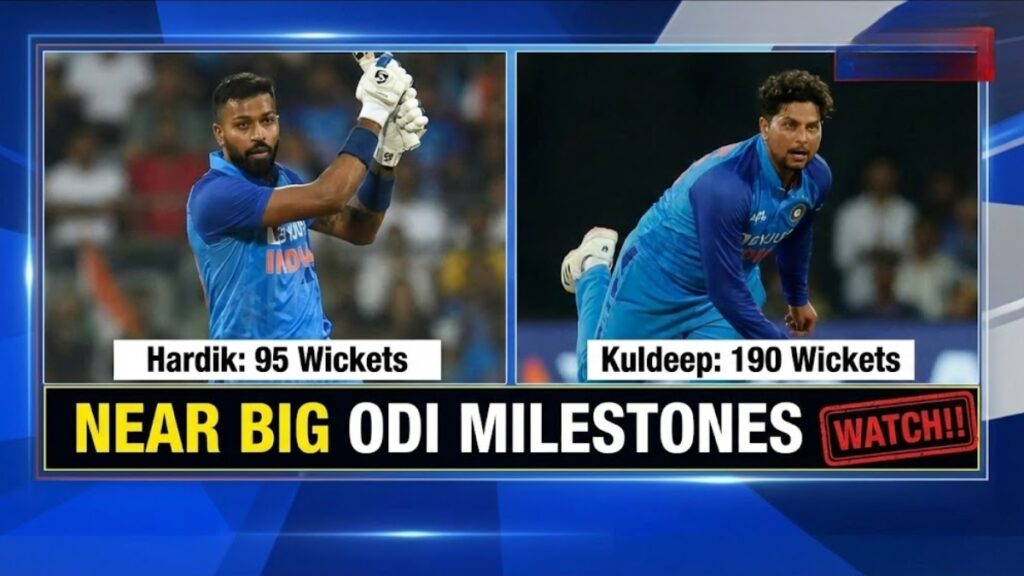
India’s three-match ODI series against New Zealand, which begins on January 11, has a subplot that is drawing as much attention as team lineups and tactics. Two of India’s key white-ball players, allrounder Hardik Pandya and left-arm wrist spinner Kuldeep Yadav, arrive in the series within touching distance of significant personal milestones that would cement their places among the modern era’s elite limited-overs performers.
The story has been captured in a photo feature and analysis by Amar Ujala, which highlights how these milestones could rewrite short-form record books for the players involved.
What each player needs and why it matters
Hardik Pandya is nearing a rare double that only a handful of ODI players have achieved: 2,000 international runs and 100 ODI wickets. According to reporting, Pandya needs roughly 96 runs and 9 wickets to reach those benchmarks, numbers that are within sight over a three-match series if he plays all games and the conditions suit his allround role. Reaching that threshold would place him in elite company alongside multi-format greats who combined genuine batting and bowling value for their countries.
Kuldeep Yadav, meanwhile, stands as India’s frontline wrist-spinner in the longer white-ball formats and is similarly close to a major bowling milestone. Over recent years Kuldeep has been one of India’s most consistent wicket-takers in ODIs.
Further wickets in this series will not only pad his career numbers but also strengthen the case for his central role in India’s preparations for upcoming ICC events, where a reliable spin option is invaluable in subcontinental conditions. The Amar Ujala piece emphasizes the symbolic weight of these markers for both players and for a team mapping its route to future tournaments.
Series context: schedule, selection and strategic value
The three ODIs are scheduled to be played in Vadodara, Rajkot and Indore. The series is one of the first international assignments India will use to fine-tune combinations ahead of critical ICC calendar events later in 2026 and beyond.
The fixtures are not standalone friendlies. They form a window for the selectors and team management to test bench strength and to see how senior players manage workload between formats. Official match listings and fixtures have been published by the BCCI.
Selection context matters. India’s management has signalled a balancing act between short-term results and long-term planning, and that calculus affects who plays, how intensively they are used, and what roles are asked of them. For players on the cusp of milestones, the selectors must weigh the value of giving them the minutes they need against broader team management and future workload planning.
Injury update and squad reshuffle
The series has not been without disruption. India’s wicketkeeper Rishabh Pant has been ruled out of the ODIs with a side strain, prompting the BCCI to bring in replacement cover. Such absences and last-minute changes shift the balance of roles and opportunities in the squad.
For example, the absence of a senior player can open up additional bowling or batting responsibility for others, which in turn can accelerate or delay milestone chases depending on how captains deploy personnel on the field.
There were earlier reports that some senior players might be rested as part of workload management ahead of heavier international commitments. That makes the series both an opportunity and a test. If Hardik plays a leading role with the ball as well as the bat, he could reach his double. If Kuldeep receives extended spells in the middle overs and finds favorable conditions, he could add the wickets he needs to climb further up the career charts.
Tactical implications for India and New Zealand
From a tactical viewpoint, both milestones are not only individual objectives but also factors that will influence match plans. Hardik’s role as a genuine pace-bowling allrounder who can bat in the lower middle order gives team management a flexible option.
If used as a sixth bowling option in seaming conditions, he could pick up wickets; if conditions favour batting, he will be expected to accelerate and chase the runs required for his milestone. That duality makes him strategically important beyond headline figures.
Kuldeep’s wrist spin poses different tactical questions. New Zealand’s batsmen traditionally handle spin well through soft hands and good use of the crease, so Kuldeep will need variations in flight, pace and angle to unsettle them.
India will likely use him to bowl in the heart of the innings where wickets are most valuable in slowing run rate and creating pressure. Each wicket Kuldeep takes could be doubly valuable: it helps the team and moves him closer to a personal benchmark that validates his role in the longer white-ball plans.
Statistical perspective and historical comparison
Milestones carry symbolic weight because they allow comparisons across eras. A figure like 2,000 runs and 100 wickets in ODIs for an allrounder is a sign of sustained, high-impact contribution in multiple disciplines. Historically, players who have combined significant runs and wickets at the ODI level have been game-changers for their sides. For bowlers, reaching career landmarks often correlates with the ability to perform across conditions and opponents. As such, both players’ pursuit is not merely a headline—it is a testament to longevity, adaptability, and the trust placed in them by successive team managements.
What success would mean for team dynamics
If Hardik achieves his double, India would gain a hardened, multi-format option around which they can build flexible strategies, particularly in tournaments that demand depth and balance. Kuldeep hitting his wicket milestones would consolidate India’s spin depth and give the team management confidence to use him as a primary spinner in conditions that favour slow bowling. Both outcomes would also ease selection dilemmas and permit clearer workload distribution among seamers and spinners in congested calendars.
For younger players and those on the fringes, seeing established performers reach milestones can be motivating and stabilizing. It creates a natural leadership core of experienced match-winners who have accumulated both runs and wickets at the international level.
The New Zealand challenge
New Zealand will not be mere spectators to these personal stories. Their bowling plans, field placements and batting strategies will be tuned to neutralize India’s key players and to exploit any vulnerabilities. Wicket types, pitch preparation and in-game adjustments will all matter.
A disciplined New Zealand bowling unit that can rotate the strike, bowl tight lines and make early breakthroughs could limit the opportunities for Hardik and Kuldeep. Conversely, if New Zealand’s batting is porous against spin or if they overcommit against swing, the conditions will favour India’s milestone chases.
Fan interest and media framing
Milestone chases add narrative spice to bilateral series. Media coverage and fan engagement tend to heighten when personal records are in sight. Photo galleries and features, like the Amar Ujala piece, help shape public interest and provide visual context to statistical narratives. For broadcasters and digital platforms, such storylines increase viewer engagement and create additional talking points during match coverage.
Outlook: cautious optimism
Neither milestone is guaranteed across three ODIs. Cricket is a sport of margins and opportunities. A three-match window is short, and factors such as pitch behaviour, match situation, captaincy decisions and sheer randomness will influence whether either player reaches their targets. Still, both Hardik and Kuldeep enter the series with form, reputation and tactical roles that make the milestones plausible rather than fanciful.
For India, how the management chooses to deploy them will be the decisive factor. If both are given clear roles that maximize their chances to contribute in the disciplines they chase, the series could be the stage where personal landmarks meet team objectives. If the emphasis falls strictly on rotation and rest, the milestones may have to wait for the next international window.