
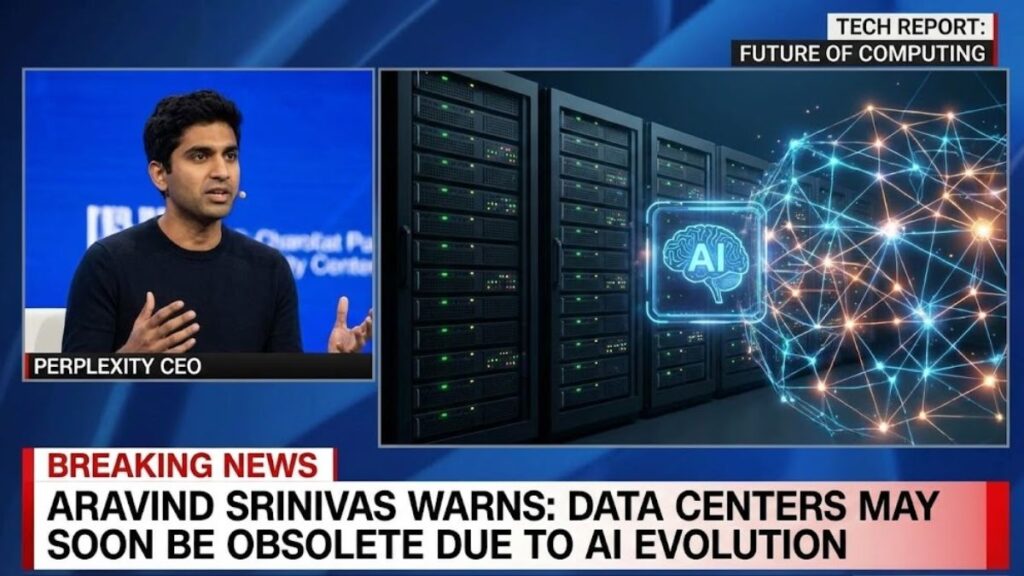
San Francisco / Bengaluru, January 5, 2026 — Aravind Srinivas, CEO of AI search pioneer Perplexity, has sounded a dramatic caution for the technology industry: the massive physical data centers that power today’s cloud and internet services may soon face obsolescence unless they adapt to new efficiencies driven by generative AI and emerging computing paradigms.
In a keynote earlier this week, Srinivas described data centers — long the backbone of global digital infrastructure — as “one of the biggest economic and technological bottlenecks of the next decade” if their soaring costs and energy demands aren’t mitigated by architectural innovation. The stakes are high: trillions of dollars in existing data-center assets and future build-outs could be reshaped if his projections play out.
His comments — echoing growing industry debate — have reverberated across boardrooms, cloud-computing forums and investor circles, raising fundamental questions about where and how computing gets done in the AI era.
What Srinivas Warned: “Obsolete” Is Not Hyperbole
At a technology summit in the U.S., Srinivas was blunt about the current state of data centers. Built around legacy architectures originally designed for general-purpose workloads, he said, modern data centers are straining under the explosive demand for generative AI, large-scale machine learning models, and real-time inference systems that require massive data movement, low latency and high energy throughput.
In his view, current facilities — even the cutting-edge cloud campuses owned by Microsoft, Google, Amazon and Meta — are facing a looming efficiency ceiling. Without radical change:
- Operational costs will skyrocket due to energy consumption and cooling needs
- Performance bottlenecks will grow as AI workloads outpace hardware scaling
- Carbon emissions and sustainability pressures will intensify under regulatory and environmental scrutiny
Perplexity’s CEO warned that the industry risks building “glorified server farms that cannot cost-effectively support next-gen AI workloads,” and that the economic model underpinning data-center investment may have to be revisited.
Why Data Centers Are Under Pressure
To understand why Srinivas’s warning captures attention, it helps to review the forces reshaping computing:
1. Exponential Growth of AI Workloads
Modern generative AI models — billions to trillions of parameters strong — demand enormous compute power for both training and inference. These models typically run across clusters of GPUs or specialised AI accelerators, pushing server infrastructure to the limits. As model sizes double or triple, so too does the demand for memory bandwidth, interconnect speed and power delivery.
2. Energy and Sustainability
Data centers are among the largest industrial electricity consumers globally. As AI workloads surge, so do their energy footprints. Regulatory regimes in Europe, the U.S. and Asia are tightening emissions reporting and energy-efficiency standards, putting added pressure on data-center operators.
3. Cloud Cost Economics
For enterprises using public cloud services, margins on compute are already slim. As AI workloads become standard business tools, CFOs and CTOs are questioning the long-term cost viability of centralized cloud processing versus alternative architectures.
Taken together, these forces suggest that simply building more and bigger data centers is unlikely to be a sustainable answer.
What Srinivas Sees as the Future
Rather than accept the status quo, Srinivas advocated for a strategic pivot in computing design — one that shifts away from monolithic cloud data centers toward heterogeneous, distributed and specialised architectures capable of handling AI’s unique workload profile.
Key Tenets of His Vision:
Edge and Distributed AI Compute
Srinivas predicts that AI compute will decentralise, with more processing pushed to the edge — closer to where data is generated and consumed. This reduces latency and offloads traffic from central facilities.
AI-Native Chip and System Designs
He emphasised the industry’s shift from general-purpose CPUs toward purpose-built AI accelerators — including GPUs, TPUs, and novel silicon (neuromorphic, optical and other specialised processors). These designs are more energy efficient for matrix multiplication-heavy AI workloads than traditional server CPUs.
Adaptive, Serverless AI Frameworks
Srinivas also foresees serverless AI frameworks that dynamically allocate compute based on real-time demand, rather than pre-provisioned capacity — a model that could dramatically reduce idle infrastructure and wasted energy.
In his view, this mix of edge compute, specialised hardware and smarter workload scheduling could effectively phase out the need for some traditional data-center structures over time.
Industry Reactions: Alarmed and Supportive
Reactions to Srinivas’s warning have been mixed:
- Cloud incumbents generally acknowledge the trends but caution that data centers will still play a foundational role for years, especially for large enterprises and foundational model training.
- Chip designers and AI infrastructure startups broadly welcomed the call for innovation, arguing that existing hardware stacks are indeed sub-optimal for large AI tasks.
- Energy and sustainability advocates saw the critique as timely, since data-center power usage is a growing environmental concern, particularly in regions reliant on fossil fuels.
“We’re not saying data centers will vanish overnight,” one major cloud provider executive told Tech Observer. “But the economics of centralised compute are shifting, and we need a hybrid future.”
Comparative Context: Global Trends in Compute Architecture
Srinivas’s concerns align with broader shifts observed in the wider tech ecosystem:
Hyperscale Cloud Limits
Hyperscale data centers — enormous facilities with tens of thousands of servers — have been the foundation of cloud services for over a decade. However, their costs and energy use scale poorly as AI becomes ubiquitous.
Rise of AI Micro-Data Centers
Companies like Nvidia, Microsoft, Google, AWS and startups increasingly deploy micro-data centers or AI pods closer to urban centres and edge gateways — smaller clusters optimised for specific AI workloads.
On-Chip AI Models
With tiny, efficient AI models now running on smartphones and cars, many AI tasks — especially inference — no longer require massive server farms. This trend helps decentralise compute even further.
In essence, the future of compute may be multi-layered, with central data centers handling foundational model training and long-range big-data tasks, while edge and distributed systems handle inference and latency-sensitive workloads.
Economic Implications for Data-Center Investors
Srinivas’s warning has triggered discussions among investors and infrastructure firms. Some of the key implications being debated:
- Asset Write-Down Risks: If older data-center farms can’t be repurposed or upgraded, they may lose value rapidly.
- Shift to AI-Optimised Facilities: Investors could start favouring facilities designed specifically for AI compute rather than generic server hosting.
- Opportunity in Edge Infrastructure: Major telecoms and cloud companies are investing in edge data hubs, partly driven by 5G and IoT adoption.
One infrastructure fund manager told Economic Tech Review: “If you’re betting on vanilla data centers, you’re on thin ice. The future is AI-native compute infrastructure.”
Answers to Common Questions
Q: Are data centers really going away?
A: Not in the short term — but their role may fundamentally evolve. Srinivas and others argue they will become more specialised and distributed rather than obsolescent in the near future.
Q: What will replace traditional centralized data centers?
A: A combination of edge compute facilities, AI-optimised micro-data centers, purpose-built chips, and distributed AI frameworks.
Q: What does this mean for cloud providers?
A: They may need to re-architect their networks toward hybrid models, integrating central and edge compute more seamlessly.
What Comes Next in Tech Infrastructure
Several trends will play out over the next few years:
- More efficient AI silicon: Focused on energy-per-operation and specialised accelerators.
- Cloud–Edge hybrids: Platforms that automatically distribute workloads to the most efficient compute layer.
- AI workload orchestration: Tools that predictively move data and compute to minimise latency and power use.
Analysts conclude that while data centers will not disappear tomorrow, the economic model behind them will change drastically — and companies slow to adapt could find their long-term investments stranded.
Bottom Line
Perplexity CEO Aravind Srinivas’s warning is no mere sound-bite; it reflects a tectonic shift in how computing is done. As AI workloads grow exponentially and sustainability pressures mount, the era of one-size-fits-all data centers may be winding down.
The future, according to Srinivas and many industry watchers, lies in specialised, distributed and AI-efficient architectures — a transformation that could reshape cloud economics, infrastructure investment and the very foundation of digital services globally.
Summary
- Perplexity CEO Aravind Srinivas warned that traditional data centers could become obsolete if they fail to evolve to meet the efficiency demands of generative AI and emerging compute patterns.
- Key factors driving change include AI workload growth, energy costs and sustainability mandates.
- Future computing may be decentralised, specialised and purpose-built for AI, with greater emphasis on edge and micro-datacenter architectures.
- The warning has sparked industry discussion on investment risk, cloud strategy and the economics of compute infrastructure.