
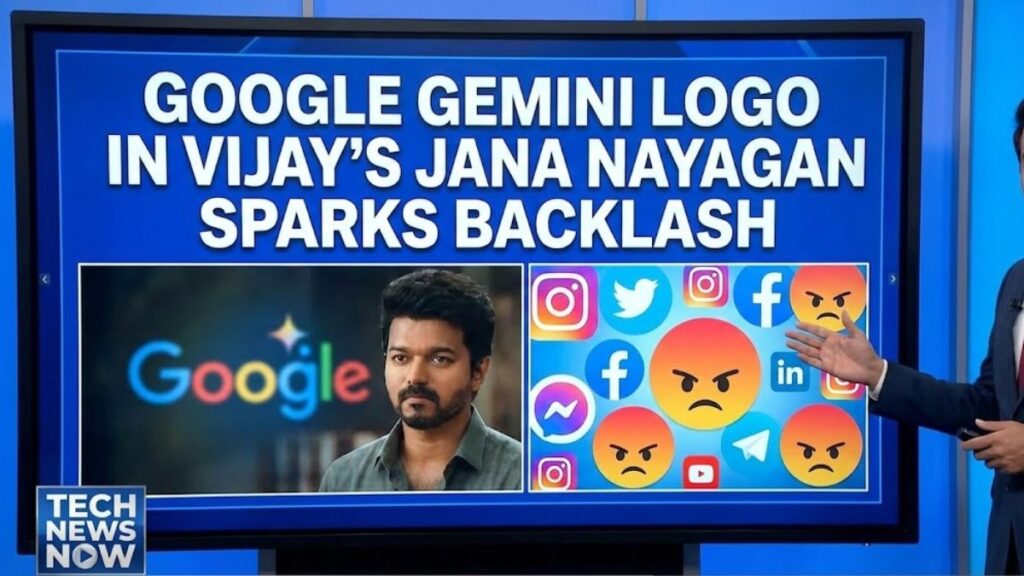
A tiny logo has blown up into a big controversy. The trailer for Jana Nayagan, the highly anticipated new film starring Tamil superstar Vijay and billed as a Rs 400 crore production, briefly showed a Google Gemini watermark in one frame, prompting outraged reaction from fans and a wider conversation about the role of generative AI in mainstream filmmaking.
The watermark was visible when the trailer first went live and was removed by the time Hindustan Times rechecked the clip the following morning.
The moment was short and easy to miss. Still, eagle-eyed viewers captured screen recordings and posted them on social platforms, where the sight of an AI company logo inside a multimillion-dollar film’s trailer quickly drew ridicule and anger.
Critics called it an amateur mistake, especially given the film’s scale, and many accused the production team of taking an unacceptable shortcut.

What happened, and where it showed up
The controversy centers on a flash frame around the 23-second mark of the trailer. In the sequence a man cocks a shotgun and, in the next instant, a small Gemini logo appears in the lower corner of the shot. Within hours, social media users had shared slowed clips and stills that highlighted the watermark. Hindustan Times reported that when the site checked the trailer the next morning, the logo had already been removed from the public cut.
Multiple Indian outlets picked up the story, noting both the error and the scale of the backlash. Viewers questioned how such an obvious watermark could survive editing and quality checks on a project of this budget and visibility. Some responses were scathing. “400-crore budget, but what is this, man?” one comment read. Another poster called the presence of an AI watermark “an absolute insult” to the craft.
Why people are angry beyond the watermark
The reaction fused two anxieties. First, audiences see the Gemini mark as evidence that AI tools were used to generate or assist in visual elements of the trailer. For fans expecting practical stunt work, large-scale choreography, or physical effects in a star vehicle, the suggestion of AI substitution felt like cheapening the effort. Second, the watermark created the impression of sloppiness. If a major studio release can slip an obvious logo into the final export, viewers worry about wider lapses in quality control.
Those concerns exist within a larger global debate about AI in entertainment. Hollywood and the streaming world spent much of 2025 wrestling with the legal and ethical questions raised by generative tools. Platforms have already begun removing fake or AI-generated trailers and deepfakes, and trade discussions about disclosure, consent and contract language for digital likenesses have accelerated. The Jana Nayagan moment landed into that charged context, and critics quickly used it to argue for clearer standards.
Production response and what may have gone wrong
At the time of reporting, neither KVN Productions nor the film’s director had issued a public technical explanation about how the watermark appeared. Several likely scenarios are being discussed in industry circles and on social media.
One possibility is that a VFX or editing vendor used a trial or preview render of an AI tool and forgot to export a clean pass. Another is that a placeholder asset from a generative workflow was not replaced before final export. Either way, professionals say the mistake is avoidable with straightforward review steps, especially on a high profile release.
Some commentators noted that producers often pull together multiple vendors, freelance visual effects teams, and last-minute edits when assembling teasers and trailers. That complexity can increase the risk of an oversight, though it does not excuse a visible watermark in a major promotional piece. Industry observers say the safer practice is always to publish a verified master and run a final legal and technical check before public release.
The broader debate: AI tools, disclosure and audience trust
Jana Nayagan’s trailer controversy is more than a headline. It is a practical example of the trust question the entertainment industry faces as generative AI becomes a production tool. Studios and creators who use AI for previsualization, background enhancement, or set extension may have sound creative reasons to do so. But audiences increasingly expect transparency and professional rigor. Incidents like this feed calls for clearer disclosure when AI significantly contributes to a finished product.
Major platforms have already taken steps to combat deceptive uses of AI in promotional content. YouTube, for example, recently purged a wave of fake, AI-driven trailers and tightened enforcement on inauthentic content. Those moves set a precedent that makes any visible watermark or unlabelled AI asset in official clips especially combustible.
Why it matters for Vijay and Jana Nayagan
For Vijay, Jana Nayagan carries added significance. Reported as a high budget, star-led political action drama and widely framed as the actor’s penultimate or final major release before a planned political entry, expectations were high. The trailer had already attracted huge view counts and intense attention. That amplified the disappointment when the watermark was noticed. Some fans framed their anger as a protection of the actor’s legacy, while others criticised the production values for such a landmark project.
Commercially, the misstep is unlikely to derail box office prospects by itself, but it does underscore the vulnerability of big tentpole releases to social media scrutiny. Publicity will now split between excitement for the film and debate over production practices. Producers will have to manage both heat and expectations leading into the film’s release on January 9.
What to watch next
Two things are likely to follow in the short term. First, the filmmakers or studio may issue a technical clarification about the watermark and the steps they will take to prevent such oversights. Second, the incident will likely accelerate conversations inside the Indian film industry about standards for AI use and disclosure in promotional assets. Given how quickly the clip was removed and how loud the response became, the episode may prompt immediate internal review measures among major production houses.
Summary
A brief Google Gemini watermark in the Jana Nayagan trailer has turned into a larger conversation about quality control and AI ethics in filmmaking. Fans reacted angrily to what they saw as an avoidable mistake on a high budget film, and the clip’s quick removal did not stop the debate. As studios increasingly use generative tools, incidents like this show why transparency, robust review workflows and clear disclosure policies will matter more than ever. Hindustan Times+1