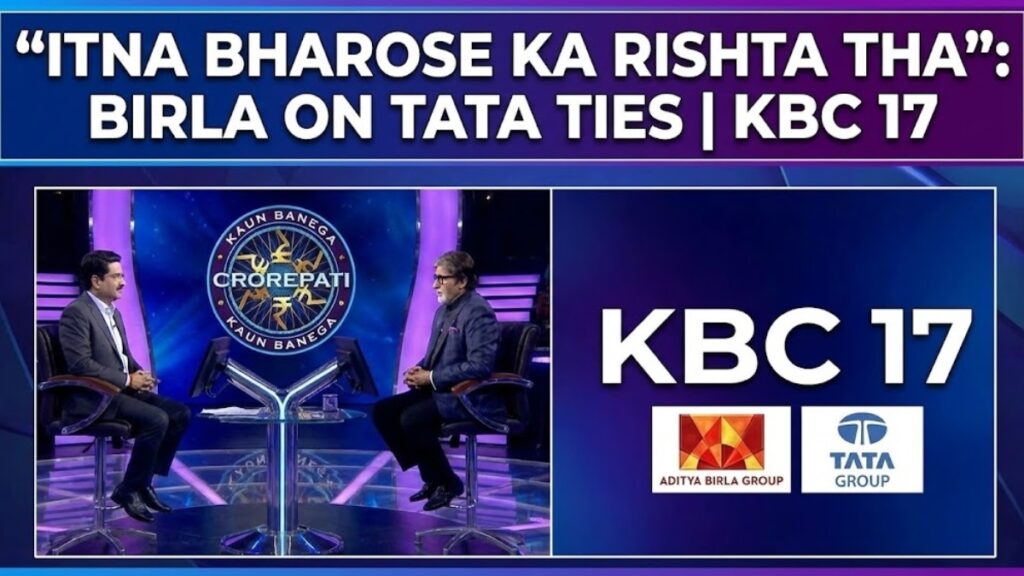
New Delhi, December 30, 2025 — In a rare and candid television appearance, Kumar Mangalam Birla, Chairman of the Aditya Birla Group, offered viewers an intimate look into India’s corporate history and personal relationships during his special episode on Kaun Banega Crorepati (KBC) Season 17.
Hosted by Amitabh Bachchan, the episode went far beyond business trivia, revealing stories of trust, family values, and long-standing ties between two of India’s most influential industrial families — the Birlas and the Tatas .
The conversation struck a chord with audiences not only because of Birla’s stature in Indian industry, but also because of his reflections on Ratan Tata, one of the most respected figures in Indian corporate life. Birla’s words painted a picture of an era where business relationships were built on credibility, shared values, and mutual respect, rather than just balance sheets.
A Rare Glimpse Into Corporate History on Prime-Time TV
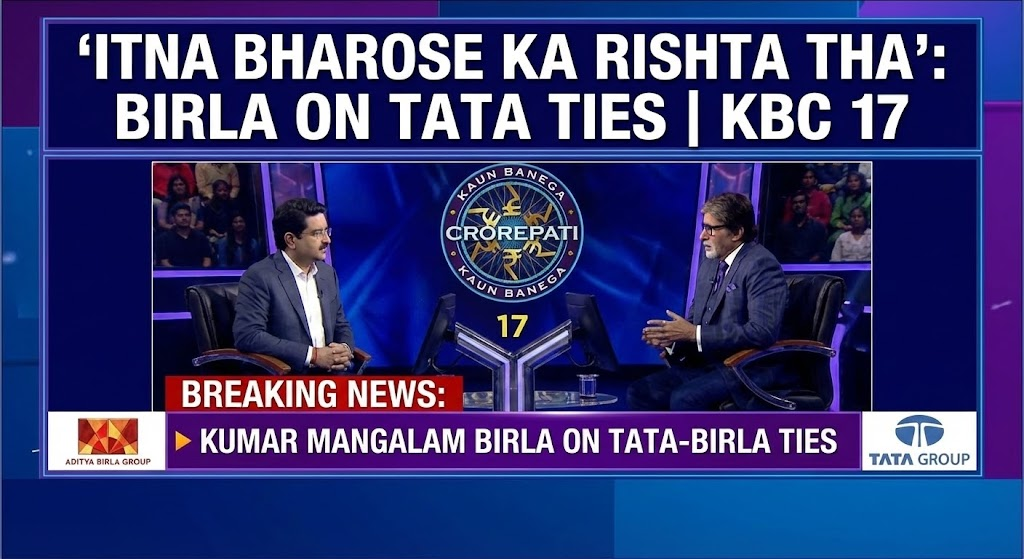
KBC has long been known for blending knowledge with emotion, but Birla’s appearance stood out for its historical depth. When asked about the relationship between the Birla and Tata families, Kumar Mangalam Birla recalled a time when the Birlas held significant shareholdings in some Tata companies, a fact not widely known to the public.
“Itna bharose ka rishta tha,” Birla said, explaining that the relationship was grounded in trust rather than rivalry. His remark highlighted a phase in Indian industrial history when leading business houses often supported each other, driven by long-term vision and shared national goals rather than short-term gains .
In today’s corporate environment, marked by intense competition and global pressures, such an admission offered a refreshing reminder of a more collaborative past.
Birla–Tata Relationship: Beyond Competition
The Birla and Tata groups are often portrayed as competitors, given their presence across key sectors such as manufacturing, metals, telecom, cement, and consumer goods. However, Birla’s recollection challenged this simplistic narrative.
He emphasized that mutual respect between industrial families played a crucial role in shaping India’s post-independence industrial ecosystem. During decades when India was still building its economic foundations, relationships among business leaders were often guided by a sense of responsibility toward the nation.
Ratan Tata, Birla noted, embodied values of integrity, humility, and long-term thinking, qualities that earned him admiration across business houses, not just within the Tata Group. These values, Birla suggested, were the cornerstone of the trust shared between the two families .
Personal Memories of Ratan Tata
While Birla did not dwell on specific private interactions, his tone conveyed deep respect for Ratan Tata as both a business leader and a human being. He described Tata as someone who believed in institution-building rather than personality-driven leadership, a philosophy that resonated strongly with the Birla family’s own traditions.
For viewers, this was a rare moment where two towering corporate legacies intersected on a human level. In an era where corporate leaders often appear distant, Birla’s reflections made Indian industry feel personal and relatable.
Lessons From Family Legacy
The KBC episode also delved into Birla’s own family background. He spoke about the influence of his late father Aditya Vikram Birla, who transformed the group into a multinational conglomerate, and his grandfather Basant Kumar Birla, who emphasized discipline, simplicity, and ethics.
Birla credited his family for instilling in him a belief that business success must go hand in hand with social responsibility. These lessons, he said, helped him navigate one of the most challenging transitions in Indian corporate history — taking over the Aditya Birla Group at the age of 28 after his father’s sudden demise.
The audience saw a side of Kumar Mangalam Birla that rarely emerges in boardroom discussions: a son shaped by legacy, expectation, and responsibility.
Trust as a Business Currency
One of the most powerful themes from Birla’s appearance was the idea of trust as a currency in business. By recalling how the Birlas once held larger stakes in Tata companies, Birla underscored that such arrangements were possible only because of deep faith in each other’s intentions.
This trust, he suggested, allowed Indian businesses to survive and grow despite regulatory hurdles, limited capital access, and economic uncertainty in earlier decades. It also fostered stability during times when formal corporate governance structures were still evolving in India.
In many ways, Birla’s comments served as a subtle critique of today’s hyper-transactional corporate culture, where relationships are often driven purely by shareholder value.
Why the Episode Resonated With Viewers
Social media reactions following the episode reflected widespread appreciation for Birla’s humility and openness. Many viewers noted that seeing one of India’s richest and most powerful industrialists speak about relationships, gratitude, and legacy felt refreshing in an age dominated by sound bites and financial headlines.
KBC has historically provided a platform for such moments — where public figures step away from their official personas. Birla’s episode fit squarely into this tradition, blending business history with personal reflection.
Indian Corporate Culture: Then and Now
Birla’s remarks also sparked broader discussions about how Indian corporate culture has evolved. In earlier decades, industrial families often shared informal bonds, sometimes collaborating to protect domestic industry during restrictive economic policies.
Today, Indian corporations operate in a globalized environment, competing with multinational giants and navigating complex regulatory frameworks. While professionalism and transparency have improved, Birla’s comments reminded viewers that ethical relationships and long-term trust remain irreplaceable assets.
KBC as a Platform for Business Storytelling
That such reflections emerged on a quiz show speaks volumes about KBC’s cultural role. Over the years, the show has become a space where India’s leaders — from politicians to entrepreneurs — share personal journeys with a mass audience.
Amitabh Bachchan’s measured and respectful hosting style allowed Birla to speak candidly, turning what could have been a promotional appearance into a meaningful conversation about values, history, and leadership.
Insights: Why Birla’s Words Matter Today
From an analytical perspective, Birla’s comments arrive at a time when corporate governance, trust, and ethics are under intense scrutiny globally. As businesses face pressure from investors, regulators, and society, stories of trust-based relationships offer valuable lessons.
They remind us that sustainable success is rarely built overnight, and that reputations forged over generations can be undone quickly if values are compromised. Birla’s emphasis on trust aligns closely with the Tata Group’s long-standing philosophy, making his tribute to Ratan Tata particularly significant.
Conclusion
Kumar Mangalam Birla’s appearance on Kaun Banega Crorepati 17 was more than a television moment. It was a window into India’s industrial soul, revealing how relationships, trust, and shared values helped shape some of the country’s most powerful business institutions.
By recalling the deep bond between the Birla and Tata families and paying tribute to Ratan Tata’s integrity, Birla offered viewers a reminder that behind every corporate empire lies a human story. In a rapidly changing business world, his words served as a timely reflection on what truly sustains success — trust, respect, and legacy .