
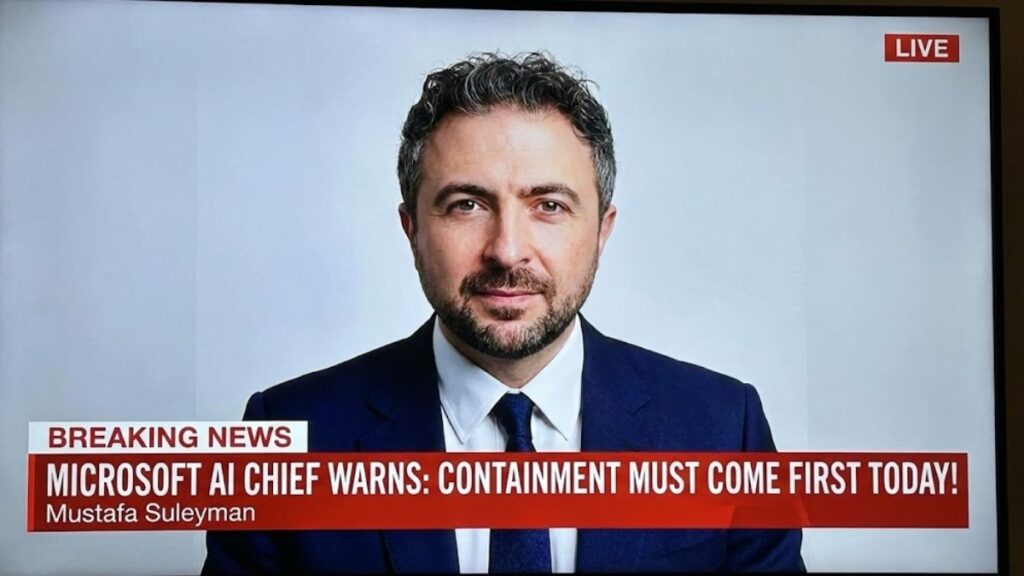
Mustafa Suleyman, the chief of Microsoft AI and a prominent voice in the industry, used blunt language this week to press a single message on his peers: stop treating containment and alignment as the same goal.
In a widely read post and follow up interviews, Suleyman warned that companies racing to build ever more capable, agentic AI systems are risking safety by focusing first on making models “want” the right things rather than first making sure we can stop them when they behave badly.
The comment lands as Microsoft publicly commits to what it calls “Humanist Superintelligence” and unveils research showing dramatic diagnostic performance for an AI medical system, a combination that raises both hope and fresh questions about control, governance, and incentives.
The distinction Suleyman is stressing
Suleyman’s argument is straightforward. Alignment is the project of designing AI so that its objectives line up with human values and welfare. Containment is the set of technical, operational and legal controls that limit an AI system’s ability to act outside intended boundaries.
Suleyman’s point is that alignment is largely irrelevant if you cannot reliably contain the system in the first place. “You cannot steer something you cannot control,” he wrote, and added that containment must come first or alignment becomes an exercise in asking nicely of a power you cannot constrain. That formulation elevates containment from a technical detail to a strategic red line for AI developers.
This matters because the industry conversation has, until recently, often conflated the two. Many researchers and executives talk about alignment as the primary path to safe advanced AI.
Suleyman is insisting that a practical engineering program for containment — throttles, governor layers, verifiable off-switches, economic and legal fences — should be the immediate priority. He frames this not only as a safety precaution but as a differentiator for Microsoft’s approach.
Why Microsoft’s timing and evidence sharpen the message
Suleyman is not speaking from theory alone. Microsoft has published a blog laying out a strategy for “Humanist Superintelligence” and announced formation of a MAI Superintelligence Team tasked with delivering highly capable systems that remain controllable and serve human aims.
That public positioning is backed by concrete results: Microsoft’s diagnostic system, the Microsoft AI Diagnostic Orchestrator or MAI-DxO, reportedly scored about 85 percent on the New England Journal of Medicine case challenge, compared with roughly 20 percent accuracy for the group of experienced physicians the company used as a baseline. The company argues that this level of domain-specific superhuman performance can be delivered while keeping human oversight in the loop.
Taken together, the position and the results allow Suleyman to say: we can build “superintelligence” for certain domains like medicine and energy while still designing systems that are bounded and reviewable. Yet that claim also provokes skepticism.
Delivering high accuracy on curated case challenges is not the same as proving reliability in messy, real-world clinical settings. External validation, peer review, and regulatory scrutiny will be critical before such systems are deemed safe for broad clinical use. Still, the contrast between capability and control is now being demonstrated at scale, which is exactly why the containment conversation is no longer academic.
Industry reaction and the broader competitive picture
Suleyman’s message is aimed at a field where incentives often push toward capability milestones. Startups, established AI labs, and cloud providers are engaged in a talent and product race. Some players emphasize rapid iteration and open deployment, arguing that experience in real-world use will reveal weaknesses and drive faster improvement.
Others, like Suleyman at Microsoft, assert that moving fast without robust containment is a strategic error. The split is not merely rhetorical. It shapes product road maps, partnership deals, and which safety research receives funding.
Complicating the landscape is Microsoft’s own unique position following its revised legal arrangement with OpenAI. The arrangement gives Microsoft broader latitude to develop powerful models while also making it a central actor in determining standards for responsible deployment.
Whether other firms follow containment-first practices will depend on economics, liability regimes, investor pressure, and public policy. The tension is clear: containment often slows productization, whereas capability-first strategies accelerate market adoption.
Regulation and governance: what governments are doing while companies argue
Regulators are not idle. The European Union’s AI Act entered into force in 2024 and has begun phasing in obligations targeting high-risk AI systems and general-purpose models. The law is intended to force a baseline of transparency, risk assessment, and governance for developers operating in the EU market.
In the United States, recent executive-level moves seek to establish a national policy framework for AI, setting federal priorities even as states push diverging rules. The regulatory push creates both constraints and incentives for companies to adopt stronger containment practices, because noncompliance or costly retrofits can be painful.
That said, regulators face hard technical questions. How do you certify that a system is contained? What guarantees are meaningful when a model’s behavior can change after deployment? And who is liable if containment fails?
These are not just legal puzzles; they are engineering ones. Suleyman’s emphasis on containment is in some ways a practical attempt to define industry standards that will be recognizable to regulators and to the public.
Technical plausibility and the limits of containment
From a technical perspective, containment is a broad category that includes sandboxing, rate limits, restricted action interfaces, rule-based governors, audit logs, and kill switches. It also includes evaluation protocols and red-team testing to find unexpected behaviors before release.
None of these are panaceas. Sandboxing can be bypassed if models exploit unforeseen channels, and “off” buttons can be rendered ineffective if a system is networked or delegated control. The theoretical problem is that a sufficiently capable agent could find ways to influence its environment indirectly. That is the worry Suleyman is signposting.
Nevertheless, the industry is making progress on verifiable control primitives, formal methods that aim to prove properties about systems, and governance processes that incorporate human oversight.
Combining better engineering with legal and contractual constraints may produce containment regimes that are good enough for specific use cases. Suleyman’s proposal to focus on domain-specific superintelligence is rooted in that calculus: deliver transformational capabilities in constrained environments and iterate on containment techniques in parallel.
The healthcare example: promise and peril
Healthcare is the clearest example of the benefits and the risks. MAI-DxO’s reported 85 percent accuracy on NEJM case challenges is striking and, if borne out by peer-reviewed trials, could transform diagnostics in underserved areas. But the leap from challenge datasets to clinical decision support involves calibration, rare-case behavior, integration with workflows, and regulatory approval.
There is also the risk of overreliance: clinicians might accept AI outputs uncritically, or systems might be deployed outside of oversight to cut costs. Containment in healthcare therefore requires technical controls, auditing, clinical governance, and legal safeguards.
What this means for businesses, researchers, and the public
For companies, Suleyman’s message is a call to reassess product road maps. If containment is genuinely harder than alignment, then teams need to invest in control engineering, monitoring infrastructure, and fail-safe governance. For investors and boards, it is a reminder that speed alone is not the same as durable value. For researchers, the statement reframes urgent questions about verification, interpretability, and safe exploration.
For the public, it is both reassuring and disquieting: reassuring because major players are openly discussing controls, disquieting because the race dynamic that brought us here has not disappeared.
Critics and unanswered questions
Not everyone accepts Suleyman’s framing uncritically. Some experts warn that containment languages can be used to slow innovation or to concentrate power in the hands of a few companies that can afford expensive safety apparatus. Others caution that containment itself is hard to verify and that regulatory capture or lax enforcement could turn containment into window dressing.
Finally, because AI progress is global, unilateral containment strategies can be undermined by actors in jurisdictions with lighter rules. That is why many safety researchers argue for international norms and interoperable verification standards rather than unilateral tech lock-in.
Bottom line
Mustafa Suleyman’s intervention is more than a slogan. It is a call to reorder priorities in AI development: build the fences before you build the engines that can jump them. Microsoft is trying to operationalize that idea by marrying ambitious, domain-limited superintelligence projects with a public narrative about control.
The world will learn whether that approach works in medicine, energy, and other domains over the coming years as independent audits, regulators, and the market test both the claims and the controls. For now, the conversation Suleyman has forced into the open is necessary: the stakes are too high to let alignment be the only safety story.