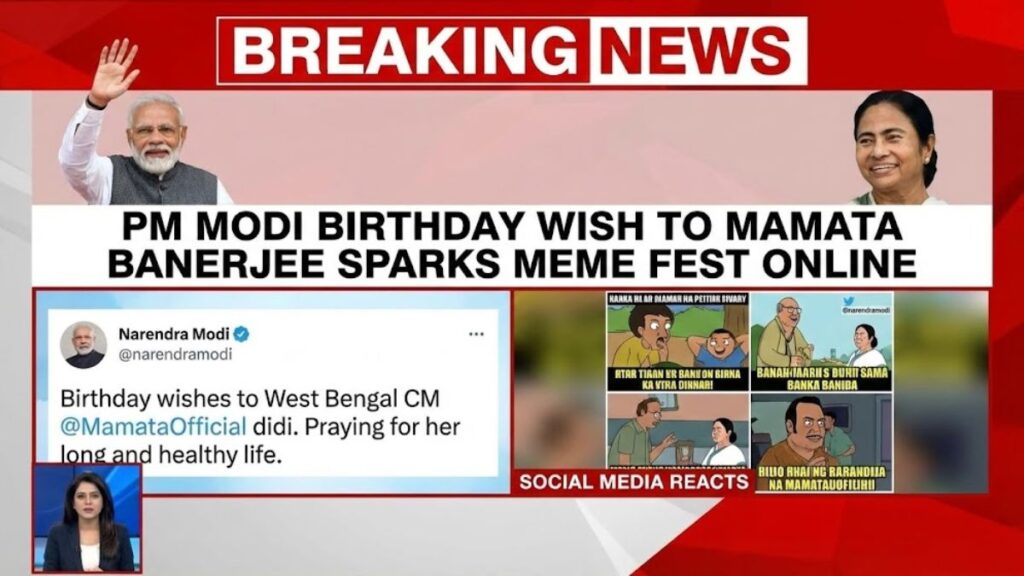
New Delhi / Kolkata, January 5, 2026 — A simple birthday greeting posted by Prime Minister Narendra Modi for West Bengal Chief Minister Mamata Banerjee on social media over the weekend quickly transformed into one of India’s most-retweeted meme surges, with users on X (formerly Twitter) turning the cordial message into an internet spectacle. The unusual online reaction reflects the blending of politics, personality and humour in the country’s increasingly vibrant digital public sphere.
What began as a polite, bipartisan gesture — Modi extending best wishes to Banerjee on her birthday — was seized upon by social-media users from across the political spectrum to create memes that referenced everything from cinema, cricket, jargon-laden wordplay and internet culture to long-running political rivalries.
Within hours of the post going live, #HappyBirthdayDidi, #MamataBirthday and a flurry of hashtag variants were trending on X in India, with memes shared tens of thousands of times.

What Modi Posted: And Why It Matters
The birthday message itself was straightforward: a respectful note wishing Mamata Banerjee good health and happiness on her birthday, signed as “Narendra Modi.” In India’s turbulent political climate — where the Prime Minister and a powerful regional chief minister often occupy competing electoral spaces — such goodwill is significant even before the memes emerged.
Political analysts say that polite greetings between elected leaders, even from rival parties, are part of democratic norms observed in many countries. But on social media, where tone and context are everything, even routine exchanges can be reframed in unpredictable ways.
The Meme Explosion on X
Within minutes of the post, users began remixing PM Modi’s message with a wide range of themes. Some of the most-shared meme categories included:
Accidental Compliments Turned Satire
Some memes took Modi’s words and hyper-polished them with humorous twists — adding Bollywood dialogues, cricket commentary or internet slang to exaggerate the apparent cordiality.
Political Rivalry Re-Framed as Pop Culture
A large set of posts recast the birthday wish as if it were a movie teaser or poster — blending images of the Prime Minister and Mamata Banerjee into everything from action films to dramatic soap operas, complete with invented taglines and punchy graphics.
Wordplay and Double Entendres
Many memes played with the wording of the birthday message itself, replacing parts of the text with puns, rhymes, and references to recurring political debates between the BJP and Trinamool Congress.
Regional and Linguistic Flavours
Memes came in Hindi, Bengali, English and Hinglish, reflecting the linguistic diversity of the audience and the different cultural frames through which political content is interpreted online.
Even as the original post remained polite, the sheer volume and variety of reinterpretations underscored how political messages become digital performance art in the social-media era.
Political Responses: From Banter to Caution
The social-media reaction drew out responses from various quarters:
- Supporters of Mamata Banerjee posted affirmative memes casting her as a celebrated leader receiving kudos from the national stage.
- Modi’s backers used the trend to highlight what they called a spirit of civil conduct across party lines.
- Critics on both sides also used the meme wave to poke fun at perceived political theatrics, palindrome puns and manufactured unity narratives.
Some commentators urged caution, noting that while humorous engagement can be healthy, oversimplification and caricature of political leaders can also detract from substantive public discourse on policy and governance.
Why This Meme Spread Took Off
Digital culture experts point to a few key reasons why this birthday wish triggered such an outsized response:
1. Familiarity of Personalities
Both Modi and Mamata Banerjee are among India’s most recognisable political figures — and rivalry between national and regional leaders is a well-tensor narrative in Indian politics.
2. Platform Dynamics
X’s real-time retweet culture and trending hashtag systems reward rapid sharing and remixing — especially when the content is open to reinterpretation or invites humour.
3. Political Saturation and Parasocial Engagement
Political communication in India increasingly takes place among online audiences who interact with content as if it were entertainment — blending serious commentary, satire and memes in a fluid way.
These dynamics mean that even straightforward political gestures can become “interactive cultural events” on social platforms.
Some Notable Memes and Reactions (Summarised)
Below are the broad themes that dominated the meme wave — without reproducing copyrighted images or content:
Pop-Culture Remix
Posts reframed the greeting as if it were a movie poster title, e.g., “Big Boss Meets Didi—The Crossover,” complete with stylised fonts and mock credits.
Cricket Infusion
Memes compared political rivalry to cricket matches, with references to captains, run chases and bonus points — playing on familiar metaphors in Indian sports culture.
Bollywood Posters
Creators inserted Bollywood actors’ faces into the template of Modi/Banerjee images — a classic Indian meme trope that blends film culture with politics.
Wordplay Captions
Users devised pun-laden captions around “birthday,” “didi,” “PM’s wish,” and related vocabulary in multiple languages, extending the humour across regional audiences.
Expert Views: Meme Culture and Political Communication
Information technology and media scholars say today’s reaction is a symptom of broader changes in how Indians engage with politics online:
Memes as Political Speech
Memes have become a form of political expression, not merely entertainment. They can carry meaning, influence perceptions, and signal group identity or sentiment.
Humor and Cognitive Frames
Humorous framing often sticks more strongly than literal text — meaning that the interpretations of a political message on X can be as influential as the message itself.
Risk of Misrepresentation
Scholars also warn that memes can misrepresent intent — fortifying polarized narratives in cases where nuance is lost.
Given these forces, even a simple birthday message becomes a site of social meaning-making — where different communities project their own interpretations and politics onto the same text.
Political & Cultural Context: Modi–Banerjee Relations
In recent years, the political relationship between Narendra Modi’s BJP government and Mamata Banerjee’s Trinamool Congress (TMC) has oscillated between competition and occasional cooperation — from election campaigns to policy disputes over federal authority and state autonomy.
Public greetings — like birthday messages or anniversary wishes — are not unprecedented in politics, but they often come under scrutiny in India’s tightly contested political climate. Supporters see such gestures as civil, opponents critique them as strategic messaging. Humour often fills the gaps in public understanding by reframing these exchanges in cultural idioms familiar to everyday audiences.
What Comes Next
As #HappyBirthdayDidi and related hashtags continue trending, the event highlights how political communication now unfolds partly on social platforms where users co-create narratives through memes and interactive responses.
For political communicators, the takeaway is clear: messages shared today are not broadcast alone — they are bait for communal reinterpretation, remix and re-publication. In this environment, simple gestures can take on multiple meanings, and the public square is as much digital as physical.
Summary
A cordial birthday wish from Prime Minister Narendra Modi to West Bengal Chief Minister Mamata Banerjee sparked a massive meme wave on X, capturing the viral energy of India’s online political culture.
What was intended as a respectful gesture became a broad canvas for humour, satire, and cultural remix — illustrating how political communication and social-media creativity now interact in unpredictable ways. The trend highlights deeper shifts in political engagement and the digital public sphere’s role in shaping political narratives.