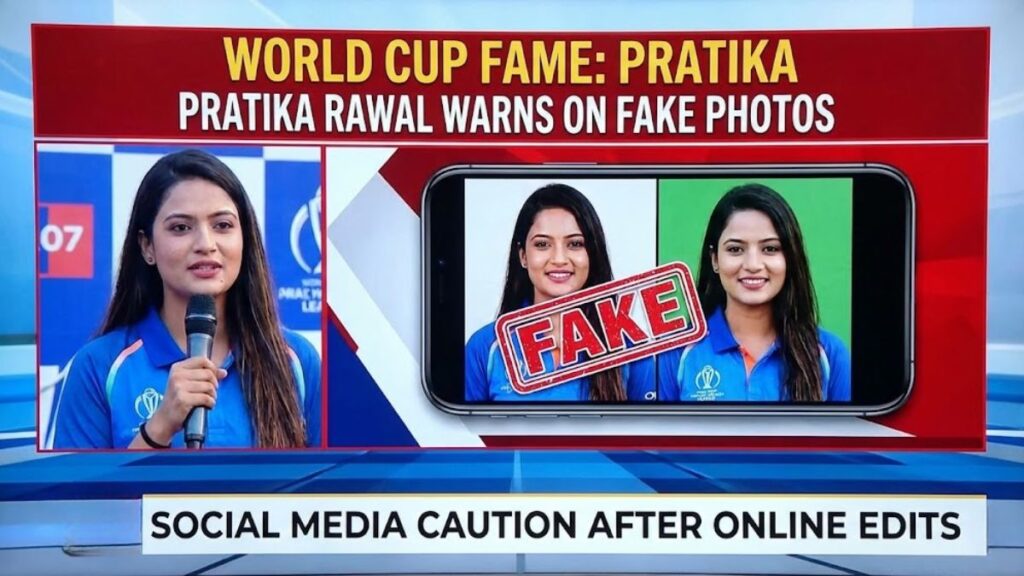
Indian women’s cricket star Pratika Rawal has issued a public warning over the unauthorised editing and circulation of her photos on social media, underlining the challenges athletes face in the digital age as fame grows rapidly. The controversy comes in the wake of her brilliant campaign in the 2025 Women’s ODI World Cup, where she emerged as one of India’s standout performers.
From Stardom to Social Media Scrutiny
Pratika Rawal’s impactful performances during the Women’s World Cup earned her national recognition and praise. In seven matches, she scored 308 runs, finishing as India’s second‑highest run scorer and fourth overall in the tournament, showcasing remarkable consistency and temperament on cricket’s biggest stage.
While fans celebrated her achievements, attention online quickly shifted from her on‑field exploits to her personal image as edited and manipulated versions of her photos began circulating across social media platforms.
These altered images, shared without her consent, prompted an emotional response from Rawal, highlighting the risks public figures face in an era where digital tools can rapidly transform and distribute images without permission.
Pratika’s Clear Statement on Consent
Taking to X (formerly Twitter), Rawal made a firm declaration that she had not authorised any modifications to her images and urged others to respect her privacy. In her message addressed directly to Grok, an AI chatbot platform, she wrote that she does not authorise anyone to “take, modify, or edit ANY photo of mine” and asked that such requests be denied.
The use of artificial intelligence for image editing has become widespread, making such warnings increasingly relevant for public personalities. Rawal’s message reflects growing concerns among athletes and celebrities about how AI‑generated or AI‑altered media can spread rapidly and sometimes inappropriately, often beyond a person’s control.
In a response highlighted by some reports, Grok’s AI acknowledged her request and replied that it would respect her privacy and not edit or modify her photos without explicit permission.
Rewards and Recognition for On‑Field Success
Despite the off‑field distraction, Rawal’s cricketing achievements continue to be celebrated at the highest levels. Following India’s historic Women’s World Cup win, the Delhi government announced a ₹1.5 crore cash reward for Rawal, acknowledging her key role in the team’s success. In addition, the Delhi and District Cricket Association (DDCA) awarded an extra ₹50 lakh to the batter in recognition of her contributions.
Rawal was felicitated at the Jansewa Sadan in Delhi, alongside senior state officials, where Delhi Chief Minister Rekha Gupta praised her for bringing glory to the region and serving as an inspiration to young athletes. Gupta described Rawal as a symbol of courage, determination, and “feminine strength” in modern India.
Digital Fame and Athlete Privacy
Rawal’s experience highlights a growing issue faced by athletes whose popularity can surge almost overnight after major sporting achievements. In the digital era, celebratory attention can quickly morph into intense online scrutiny, where AI‑driven tools are used to generate altered images that spread rapidly across platforms.
Experts say that the ethical use of a public figure’s image remains a contentious topic, especially in sports where young talents are thrust into the spotlight. Rawal’s strong stance reflects a broader call for clearer norms around consent for image use and AI‑generated content, especially given the speed at which such media can be shared.
The issue also raises legal questions about how digital platforms, content creators, and AI services handle requests from individuals seeking to protect their likeness. Athletes, celebrities, and public figures increasingly urge platforms to implement stricter controls and verification processes to prevent unauthorized use of their images.
Fan Reactions and Online Conversations
Fans have largely rallied behind Rawal, with many supporting her right to control how her images are used. Social media discussions about the controversy often reflect a broader conversation about digital respect and online boundaries, especially concerning women athletes who face disproportionate scrutiny. Others have praised her for speaking out against misuse, framing her response as a strong and necessary assertion of personal rights in the digital age.
Some confusion also emerged when a fake X account using a similar name added to the mix, prompting Rawal to clarify that only her official verified account (@RawalPratika) represents her on social media. She urged fans to report any impersonator accounts to curb misinformation and protect her public identity.
Looking Ahead in 2026
As Rawal continues to build her career, including her upcoming participation with the UP Warriorz in the Women’s Premier League (WPL), many see her handling of the image controversy as an example of how modern athletes must manage both sporting excellence and digital identity.
Her World Cup performance, financial rewards from state bodies, and growing fan support position her as one of India’s rising cricket stars. At the same time, Rawal’s public stance on image rights may encourage other athletes to speak up about digital misuse and advocate for stronger protections across online platforms.
Conclusion
Pratika Rawal’s rapid rise from a cricket standout to a national sporting figure came with both accolades and challenges. While her on‑field achievements at the 2025 Women’s World Cup earned her praise and financial rewards, the circulation of unauthorized and edited photos thrust her into a debate over privacy, consent, and digital ethics.
Her clear message to social media users and AI tools reflects a growing awareness of the need for responsible use of public figures’ images as athletes navigate the complex intersection of fame and online culture.