
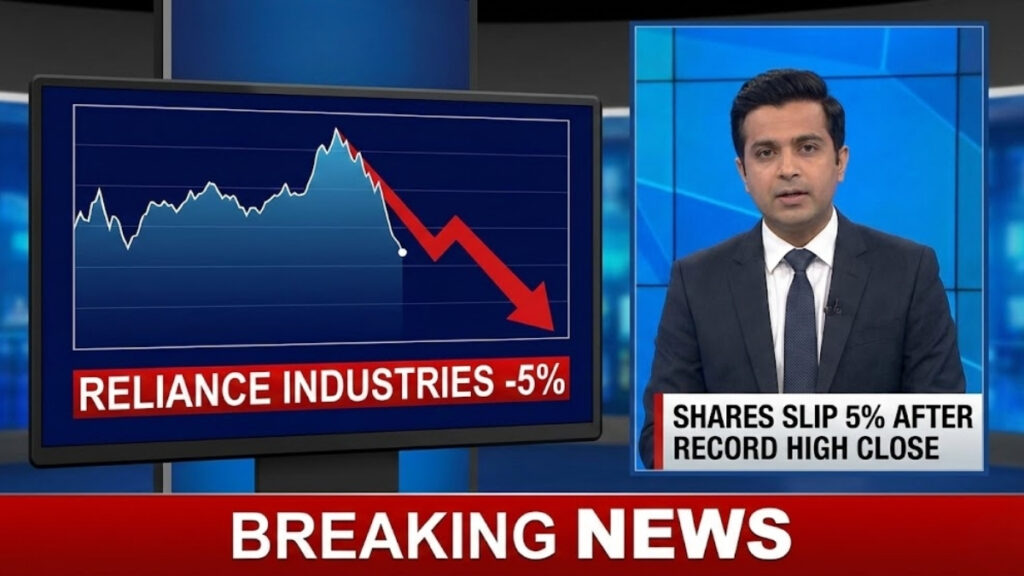
Lede: Shares of Reliance Industries Limited (RIL) tumbled intraday on Tuesday after the stock pulled back sharply a day after setting an all-time high. The fall followed a market reaction to a news report — and Reliance’s prompt denial — that briefly unsettled investors.
Key facts at a glance
- RIL fell as much as 5.18% to ₹1,496.30 on the NSE on January 6, 2026, after hitting a record high of ₹1,611.80 the previous session.
- The move came after a Bloomberg report that said three tankers carrying Russian Urals crude were signalling Jamnagar as their next destination; Reliance denied the report and said no Russian cargo had been received or was expected in January.
- Jefferies weighed in on oil-market structural shifts and potential medium-term implications for Indian refiners and oil companies. The bank noted that changes such as a possible US takeover of Venezuelan oil assets could alter crude flows and margins going forward.
- RIL remains in focus for investors because of its ambitious Reliance AI Manifesto, unveiled in late December 2025, and the company’s dominant integrated-energy, retail and digital businesses.
What triggered the sell-off
The immediate trigger was the Bloomberg piece — citing tanker-tracking data from analytics firm Kpler — that suggested at least three vessels carrying roughly 2.2 million barrels of Russian Urals crude were signalling Jamnagar as their next port of call. That report spread quickly and prompted a knee-jerk reaction in the markets.
Reliance issued a firm rebuttal, calling the report “blatantly untrue,” saying its Jamnagar refinery had not received any Russian cargo for the past three weeks and was not expecting deliveries in January. The denial did not immediately restore calm, and the stock saw profit-taking after a strong recent rally.
Analysts’ read: profit booking and headline risk
Market commentators pointed to two overlapping forces. First, profit booking after a rapid run to new highs is normal and likely contributed to the pressure. Second, headline risk around crude supply lines and input costs can prompt short-term volatility for integrated energy players like Reliance, where refining margins and feedstock sourcing are central to near-term earnings dynamics.
Jefferies flagged longer-term upside scenarios tied to shifting crude access — including potential benefits if Venezuelan supplies become easier to source — but noted that these structural factors could play out over 2027–28 rather than instantly.
Why the Bloomberg report mattered (and why the denial mattered more)
Reliance’s Jamnagar complex is one of the world’s largest refining hubs, and where its crude comes from matters for gross refining margins (GRMs). Reports that suggest advantaged cargoes are heading to Jamnagar imply a potential near-term cost advantage to Reliance.
Conversely, a denial raises questions about the original data and creates uncertainty about feedstock mix and future margins. The episode underlines how data from tanker-tracking and analytics providers can move markets — even when later rebutted.
The AI story: why RIL still attracts strategic interest
Separately, investors have been buying into Reliance’s longer-term narrative around transforming itself into an “AI-native” conglomerate. In December 2025, chairman Mukesh Ambani released a draft Reliance AI Manifesto outlining plans to embed AI across the group to lift productivity and accelerate growth across its telecom, retail, energy and digital businesses. That strategic pivot helps explain the stock’s broader momentum even as oil-related headlines create episodic volatility.
What investors should watch next
- Clarifications or follow-ups: Any further authoritative data or clarifications from tanker trackers, Bloomberg, or Reliance itself could swing sentiment.
- Refining margins and crude spreads: Updates on global crude flows, OPEC+ decisions, or US policy shifts that affect Venezuelan or Russian supplies will matter for RIL’s GRMs.
- Earnings and guidance: Quarterly results and management commentary on feedstock sourcing and margin outlook will be decisive for medium-term valuation.
- Progress on the AI agenda: Any concrete partnerships, investments, or pilot deployments linked to the AI manifesto could sustain strategic premium for the stock.
Bottom line
Tuesday’s decline looks like a classic mix of headline risk and short-term profit taking after a recent rally to record highs. The episode highlights the sensitivity of integrated energy names to crude-sourcing headlines, even as Reliance’s broader transformation story — including AI ambitions — keeps the stock on many investors’ radars.
For traders, this is a volatility event to trade; for longer-term investors, the focus remains on fundamentals: refining margins, retail and digital growth, and execution of the AI strategy.