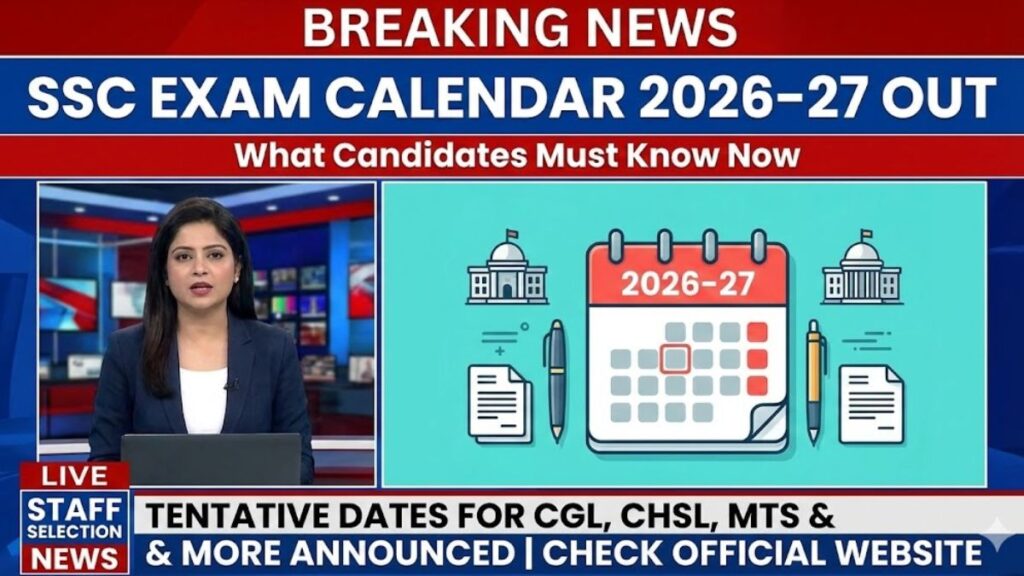
The Staff Selection Commission has published the tentative examination calendar for 2026–27, giving aspirants their first clear roadmap for major national recruitments such as CGL, CHSL, MTS, GD Constable, JE, Stenographer and several limited departmental exams. The calendar is a planning tool rather than a final timetable, but it does set realistic windows for when notifications will appear and when exams are likely to be held.
Below I break down the important dates, what the calendar actually means for your preparation, pitfalls to watch for and practical next steps you can take right away.
Quick summary: the most important facts
- The SSC calendar was released on 8–9 January 2026 and is available on the official SSC website.
- The Combined Graduate Level (CGL) 2026 notification is expected in March 2026, with the Tier 1 examination likely in May–June 2026.
- The Combined Higher Secondary Level (CHSL) 2026 notification appears around April 2026, and the exam window is tentatively July–September 2026.
- MTS and Havaldar notifications are scheduled for June 2026, with exams expected September–November 2026.
- GD Constable notifications are shown for September 2026 with the exam period in January–March 2027.
These dates are tentative and subject to change. Always check the official SSC calendar PDF and follow the Commission’s individual ads for each exam.
What the calendar contains and how to read it
The SSC exam calendar lists, for each exam, three things: the month when the advertisement or notification is expected, the likely application window, and the tentative exam period. It covers centralised recruitments and some limited departmental competitive examinations. Think of the calendar as a navigation map. Use it to mark your peak preparation weeks and to plan mock test schedules. The PDF is downloadable from ssc.gov.in.
Key exams and their tentative windows (high priority)
Here are the high load bearing items candidates usually ask about, with the tentative schedule from the calendar.
SSC CGL 2026
Notification month: March 2026. Tentative exam period for Tier 1: May–June 2026. CGL is the single most consequential SSC recruitment for graduate candidates seeking Group B and C posts. Use the calendar to time your last heavy revision and mock series.
SSC CHSL 2026 (10+2 level)
Notification month: April 2026. Tentative exam window: July–September 2026. If you plan to apply to both CGL and CHSL, note the months overlap and schedule focused blocks for each syllabus.
Junior Engineer (JE) 2026
Notification month: March 2026. Tentative exam window: May–June 2026. JE requires technical subject preparation in addition to general aptitude. Confirm branches and paper pattern in the official ad.
MTS & Havaldar 2026
Notification month: June 2026. Tentative exam window: September–November 2026. These recruitments typically have many vacancies and fast turnover.
Stenographer Grade C & D 2026
Notification month: April 2026. Tentative exam window: August–September 2026. Stenographer tests include shorthand and transcription components, so factor those skills into practice.
Constable (GD) in CAPFs, NIA, SSF
Notification month: September 2026. Tentative exam period: January–March 2027. These large scale recruitments usually involve PST/PET and document verification after the written stage.
Why the calendar matters
- Planning and pacing. If CGL Tier 1 is May–June, work backward to set milestones: concept building, problem practice, full syllabus revision and a four week mock test window. The calendar lets you avoid last minute panic.
- Avoiding clash and overload. Several exams are clustered; candidates who intend to apply for multiple posts must realistically allocate time. Overcommitting can reduce overall performance.
- Administrative readiness. The calendar signals when application windows will open so you can keep documents and certificates ready for scanning and upload.
Practical preparation checklist
- Download and save the official SSC calendar PDF from ssc.gov.in and bookmark the relevant exam pages.
- Build a backward study plan from the tentative exam month. For a May–June exam, begin full syllabus completion three months earlier and start full tests four weeks before the exam.
- Keep scanned copies of degree, caste or EWS certificates, photo ID, and passport style photo in the required format ready to upload.
- Practice on computer based mock tests. Many candidates lose marks due to navigation and timing problems, not only knowledge gaps.
- If a vacancy requires a physical test, maintain fitness routines accordingly. For Constable and SI posts, PST/PET details appear in the specific advertisement.
Common pitfalls and risks
- Tentative dates can move. Government calendars change for administrative reasons or to avoid clashes with other large exams. Treat the calendar as a guide and watch for final advertisements.
- Reading the wrong PDF. SSC keeps earlier calendars online. Confirm you are reading the 2026–27 calendar and look at the publication date.
- Underestimating document verification time. During application windows, servers sometimes slow down. Submit early and keep backups of transaction receipts.
How coaching providers and institutions will react
Coaching centres will immediately align batches and crash courses to the calendar. Expect short, intensive mock series in the two months before CGL and JE. Use coaching selectively. Prefer programs that emphasize mock tests, error analysis and adaptive feedback rather than endless theory lectures.
What the Commission’s calendar does not tell you
The calendar does not specify vacancy counts, exact exam dates, centre allocation, application fees or detailed eligibility exceptions. All these details appear only in the individual exam advertisement. Do not assume syllabus or pattern will remain identical year to year; check each notification for changes.
Next steps you should take today
- Download the official calendar PDF from ssc.gov.in and save it.
- Mark the tentative months for the exams you intend to sit and create a weekly timetable.
- Prepare scanned documents and a checklist for application day.
- Start a weekly mock test schedule if your target exam is within three to six months.
- Subscribe to official SSC notifications and one reliable exam portal or education news feed to catch final adverts as soon as they are posted.
Final word
The SSC calendar gives aspirants a valuable head start for 2026–27 recruitment. Use it to plan smartly, focus on high payoff topics and simulate real exam conditions. Treat the calendar as a tool to pace your preparation and to avoid chaotic last minute action. Keep a disciplined practice plan, watch the official SSC website for final notifications and adapt quickly if dates shift.