
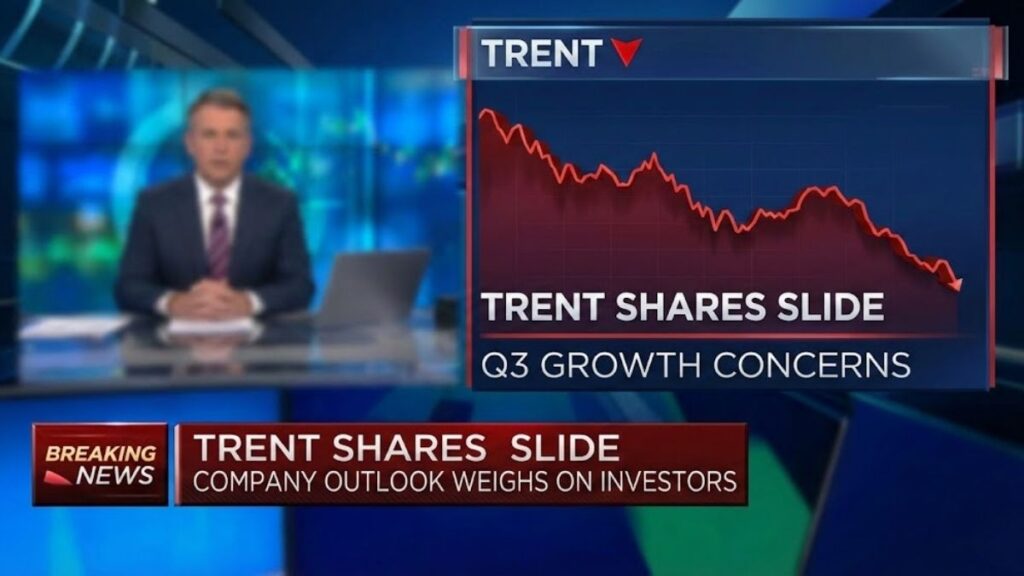
Mumbai — Shares of Tata Group-owned retailer Trent plunged on Tuesday after the company’s December-quarter business update failed to excite investors. The stock fell as much as 8.34% to an intraday low of ₹4,060 on the National Stock Exchange, with trading volumes spiking more than fourfold as traders repositioned ahead of the company’s formal quarterly disclosures. The sell-off reflected a growing investor concern that aggressive store expansion is not yet translating into the productivity gains equity markets expect.
Lede: solid top line, mixed reaction
Trent told exchanges after market hours on Monday that its standalone revenue for the December quarter rose 17% year-on-year to ₹5,220 crore, up from ₹4,466 crore in the same quarter a year earlier. On the face of it, a mid-teens revenue rise in a challenging retail environment is respectable. Yet the market reacted negatively because analysts flagged a slowing growth trajectory and signs of declining productivity at newly opened stores. The result was heavy selling and elevated volumes in Trent shares on Tuesday.
What the update said (the facts)
Key items from Trent’s business update, as reported by brokers and market outlets, included:
- Standalone revenue for the quarter: ₹5,220 crore, up 17% YoY (vs ₹4,466 crore a year earlier).
- Store network at quarter end: 278 Westside stores, 854 Zudio outlets (including four in the UAE), and 32 stores across other lifestyle concepts.
- Net new openings in the quarter: 17 Westside stores and 48 Zudio stores.
- Year-to-date (YTD) additions: Westside and Zudio added 30 and 89 stores respectively in the current fiscal period, reflecting an acceleration in expansion.
Those numbers underline Trent’s capital allocation priority: scaling up the higher-volume, value-priced Zudio chain while selectively expanding Westside, its more premium apparel and lifestyle banner. But investors focused on a separate, less flattering data point reported by analysts — a fall in average revenue per square foot.
The productivity worry: revenue per square foot slides
Citi, which modelled expectations ahead of the update, acknowledged the top-line beat — reporting a 16.9% YoY rise versus its 15.3% estimate — but warned of pressure on productivity. Its note highlighted a 15.7% year-on-year decline in average revenue per square foot, a commonly watched metric in retail that signals how effectively physical space converts into sales.
Citi and other brokers cautioned that while faster store openings support revenue growth, they could be dilutive in the near term if new outlets take time to mature and lift same-store sales.
Morgan Stanley offered a more sanguine read, saying the quarter was “largely in line” with expectations and pointing to sustained momentum in store expansion. UBS struck a more cautious tone, however, saying there was “no respite from the weaker growth trajectory” and flagging that 17% growth, while positive, was weaker than some investors had hoped. The mixed assessment from major global houses is a core reason the stock underperformed on Tuesday.
Market reaction and volumes
The market reaction was sharp and immediate. Trent shares traded heavier-than-normal, with volumes surging 4.3 times to 24.46 lakh shares compared with an average trading volume of about 5.75 lakh over recent sessions. On the BSE, 1.02 lakh shares changed hands versus an average daily volume of roughly 66,000.
By 9:44am local time on Tuesday, Trent was trading 7.11% lower at ₹4,115, underperforming the broadly flat NIFTY50. The combination of headline selling and higher turnover suggests a mix of profit-taking, short covering and portfolio rebalancing among institutional accounts.
Why investors are cautious despite expansion
At first glance, the expansion story is appealing. Zudio, a value fashion format, is scaling quickly across smaller cities and towns and is a volume driver; Westside remains Trent’s premium destination for apparel and lifestyle goods. However, three interlocking concerns are tempering enthusiasm:
Same-store productivity
A falling revenue per square foot suggests that newer stores — or the overall estate — are selling less per unit area than a year ago. That can happen if new outlets are in lower-density locations, or if customer traffic and conversion lag expectations. Productivity matters because fixed costs such as rent and staff are tied to space; lower sales per square foot compress margins until volumes recover.
Sequencing of expansion
Rapid openings are capital-intensive and often front-loaded in terms of setup costs. If new stores take longer than planned to mature, the near-term profit cycle can be muted even as topline numbers rise. Citi’s note explicitly pointed to productivity headwinds even as it acknowledged the revenue beat.
Macro and seasonal factors
Retail performance is always sensitive to seasonality, festival timing and discretionary spending. Citi highlighted that Q3 performance was impacted by an “early festive season,” which can distort quarter-on-quarter comparisons. When the festive calendar shifts, it can either concentrate or dilute sales into particular reporting periods, complicating the read on underlying momentum.
Analysts split: who is optimistic and why
The divergence in analyst reactions encapsulates the debate. Morgan Stanley retained a constructive posture, pointing to sustained expansion and the strategic rationale for scaling both Westside and Zudio. Its view implies confidence that maturation of new stores and improved assortment or execution can restore per-store productivity in coming quarters.
Citi accepted the revenue beat but sounded a note of caution on productivity and the impact of store mix and seasonal timing. UBS was blunt in its assessment that the quarter added little evidence of a reacceleration in the growth trend. These differing views leave investors to weigh short-term execution risks against the longer-term market opportunity.
Strategic tradeoffs: growth versus efficiency
Trent’s current strategy is a familiar retail playbook: scale the value chain aggressively while preserving a premium banner to capture higher margins. Zudio’s fast expansion is intended to capture share in the fragmented value segment, especially in tier-II and tier-III towns where organised apparel penetration is still rising. Westside keeps the company anchored in urban, higher-spend cohorts.
The tradeoff, however, is that scale can temporarily depress productivity metrics until stores reach steady state and the merchandising mix is optimised for local demand. Investors today appear to be focusing on the timing of that conversion from capex to sustainable cash flow.
What investors should watch next
For market participants seeking to reassess the story, several data points and milestones will be key in the weeks and months ahead:
- Management commentary in the formal quarterly results and earnings call: clarity on same-store sales trends, gross margin trajectory, and time to maturity for new Zudio outlets will be crucial.
- Quarterly gross margin and operating profit data: these will reveal whether the revenue growth is translating into incremental profitability or merely reflecting scale with dilutive productivity.
- Pace and economics of store openings: guidance on capex per store, payback timelines and target catchment economics will help investors model future cash flows.
- Festive selling dynamics and inventory management: confirmation that Trent is successfully managing inventory, markdowns and promotions will comfort investors worried about revenue per square foot declines.
- Comparable metrics from peers: how other organised apparel retailers fare in the same quarter will provide relative context for Trent’s performance.
Broader market context
Trent’s weakness in early trading is not an isolated retail phenomenon; cyclical sensitivity and headline risk routinely generate knee-jerk reactions in growth stocks. Yet for a Tata Group company with an established brand and a proven track record in India’s retail transformation, the current pullback may also present selective buying opportunities for investors who favour a longer horizon — provided the company can demonstrate recovery in productivity and margin expansion in coming quarters. The jury will remain on whether the company’s rapid rollout will deliver scale benefits quickly enough to offset temporary drags on store economics.
Conclusion: cautious optimism, but execution is king
Trent’s December-quarter update presents a nuanced picture: healthy top-line growth powered by accelerated store openings, coupled with worrying signs on space productivity. Analysts are split between optimism that expansion will pay off and caution that recent trends reflect a softer growth trajectory. Markets reacted accordingly: heavy volumes and sharp price declines as investors digested the implications.
Ultimately, the story for Trent now hinges on execution — on converting new stores into profitable, high-productivity assets — and on management’s ability to articulate a credible timeline for that conversion in the upcoming results cycle.